Tag: History

Book review: Map of a Nation by Rachel Hewitt

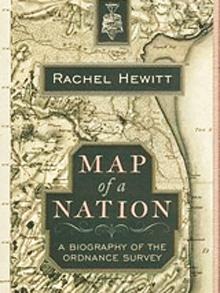
ordnanceMap of a Nation” by Rachel Hewitt is the story of the Ordnance Survey from its conception following the Jacobite Uprising in Scotland in 1745 to the completion of the First Series maps in 1870. As such it interlinks heavily with previous posts I have made concerning the French meridian survey, Maskelyne’s measurements of the weight of the earth at Schiehallion, Joseph Banks at the Royal Society, William Smith’s geological map of Britain and Gerard Mercator.

The core of the Ordnance Survey’s work was the Triangulation Survey, the construction of a set of triangles across the landscape made by observing the angles between landmarks (or triangulation points) ultimately converted to distances. This process had been invented in the 16th century, however it had been slow to catch on since it was slow and required specialist equipment and knowledge. Chromatic abberration in telescopes was also a factor – if your target is surrounded with multi-colour shadows – which one do you pick to measure? The triangles are large, up to tens of miles along a side, so within these triangles the Interior Survey was made which details the actual features on the ground – tied down by the overarching Triangulation Survey.

A second component of this survey is the baseline measurement – a precise measurement of the length of one side of one triangle made, to put it crudely, by placing rulers end to end over a straight between the terminal triangulation points.

The Triangulation Survey is in contrast to “route” or “transverse” surveys which measure distances along roads by means of a surveyor’s wheel, note significant points along the roadside. There is scope for errors in location to propagate. Some idea of the problem can be gained from this 1734 map showing an overlay of six “pre-triangulation” maps of Scotland, the coastline is all over the place – with discrepancies of 20 miles or so in places.

The motivation for the Ordnance Survey mapping is complex. Its origins were with David Watson in the poorly mapped Scotland of the early part of the 18th century, and the Board of Ordnance – a branch of the military concerned with logistics. There was also a degree of competition with the French, who had completed their triangulation survey for the Carte de Cassini and were in the process of conducting the meridian survey to define the metre. The survey of England and Wales was completed after the Irish Triangulation and after the Great Trigonometric Survey of India – both the result of more pressing military and administrative needs. As the survey developed in England more and more uses were found for it. Indeed late in the process the Poor Law Commission were demanding maps of even higher resolution than those the Ordnance Survey initially proved, in order to provide better sanitation in cities.

The Survey captured popular imagination, the measurements of the baseline at Hounslow Heath were a popular attraction. This quantitative surveying was also in the spirit of the Enlightenment. There was significant involvement of the Royal Society via its president, Joseph Banks, and reports on progress were regularly published through the Society. Over the years after the foundation of the Ordnance Survey in 1791 accurate surveying for canals and railways was to become very important. In the period before the founding of the Ordnance Survey surveying was a skill, related to mathematics, which a gentleman was supposed to possess and perhaps apply to establishing the contents of his estate.

Borda’s repeating circle, used in the French meridian survey to measure angles, found its counterpart in Jesse Ramsden’s “Great Theodolite“, a delicate instrument 3 feet across and weighing 200lbs. The interaction with the French through the surveying of Britain is intriguing. Prior to the French Revolution a joint triangulation survey had been conducted to establish exactly the distance between the Paris and Greenwich meridians, with the two instruments pitted against each other. There was only a 7 foot discrepancy in the 26 miles the two teams measured by triangulation between Dover and Calais. In 1817, less than two years after the Battle of Waterloo a Frenchman, Jean-Baptiste Biot, was in the Shetlands with an English survey team extending the meridian measurements in the United Kingdom.

The accuracy achieved in the survey was impressive, only one baseline measurement is absolutely required to convert the angular distances in the triangulation survey into distances but typically other baselines are measured as a check. The primary baseline for the Triangulation Survey was measured at Hounslow Heath, a second baseline measured at Romney Marsh showed a discrepancy of only 4.5 inches in 28532.92 feet, a further baseline measured at Lough Foyle, in Northern Ireland found a discrepancy of less than 5 inches in 41,640.8873 feet.

The leaders of the Ordnance Survey were somewhat prone to distraction by the terrain they surveyed across, William Roy, for example, wrote on the Roman antiquities of Scotland. Whilst Thomas Colby started on a rather large survey of the life and history of Ireland. Alongside these real distractions were the more practical problems of the naming of places: toponymy, particularly difficult in Wales and Ireland where the surveyors did not share the language of the natives.

Overall a fine book containing a blend of the characters involved in the process, the context of the time, the technical details and an obvious passion for maps.

Footnotes

In writing this blog post I came across some interesting resources:

Lavoisier: Chemist, Biologist, Economist by Jean-Pierre Poirier

Lavoisier

Recently I read Vivian Grey’s biography of Lavoisier. Although a fine book, it left me wanting more Lavoisier, so I turned to Jean-Pierre Poirier’s more substantial biography: “Lavoisier: Chemist, Biologist, Economist”. Related is my blog post on the French Académie des Sciences, of which Lavoisier was a long term member, and senior, member.

This is a much longer, denser book than that of Grey, with commonality of subject it’s unsurprising that the areas covered are similar. However, Poirier spends relatively more time discussing Lavoisier’s activities as a senior civil servant and as an economist.

The striking thing is the collection of roles that Lavoisier had: senior member of Ferme Générale (commissioned Paris wall), director of the Académie, director of the Gunpowder and Saltpeter Administration, owner and manager of his own (agricultural) farms. It’s difficult to imagine a modern equivalent, the governor of the Bank of England running a research lab? Or perhaps an MP with a minor ministerial post, running a business and a research lab? In practical terms he did experimental work for a few hours each morning and evening (6-9am, 7-10pm) and on Saturdays – having a number of assistants working with him.

Lavoisier was wealthy, inheriting $1.8million* from relatives as an 11 year old he joined the Ferme Générale with an initial downpayment of about $3million. However, this provided an income of something like $2.4-4.8 million a year. On a trip to Strasbourg as a 24 year old, he spent $20,000 on books – which you have to respect. As the collector of taxes levied on the majority but not the nobility or clergy, the Ferme Générale was one of the institutions in the firing line when the Revolution came. Wealthy financiers, such as Lavoisier, bought stakes in these private companies, provided exclusive rights by the King, and made enormous rates of return (15-20%), at the same time serving the Kings needs rather poorly.

As for his activities in chemistry, Poirier provides a a good background to the developments going on at the time. Beyond what I have read before, it’s clear that Lavoisier does not make any of the first discoveries of for example, oxygen, carbon dioxide or nitrogen, nor of the understanding that combustion results in weight gain. But what he does do is build a coherent theory that brings all of these things together and overthrows the phlogiston theory of combustion. With Guyton de Morveau he develops a new, systematic, way of naming chemicals which is still used today and, as a side effect, embeds his ideas about combustion. It’s from this work that the first list of elements is produced. Furthermore, Lavoisier sees the applications of the idea of oxidation in explaining “chemical combustion” as entirely appropriate for understanding “biological combustion” or respiration. In a sense he sets the scheme for biochemistry which does not come to life for nearly 100 years, for want of better experimental methodology.

It’s interesting that gases are arguably the most difficult materials to work with yet it is their study, in particular understanding the components of air, which leads to an understanding of elements, and the “new chemistry”. Perhaps this is because gases are their own abstraction, there is nothing to see only things to measure.

The book also gives a useful insight into the French Revolution for someone who would not read the history for its own sake. The heart of the Revolution was a taxation system that exempted the nobility and the clergy from paying anything, and a large state debt from supporting the American War of Independence. Spending appears to have been decided by the nobility, or even just the King, with little regard as to how the money was raised. At one point Paris considered an aqueduct to bring in fresh water to all its citizens, but then decided that rebuilding the opera house was more important! The Revolution was a rather more drawn out than I appreciated with Lavoisier at the heart of the ongoing transformation at the time of his execution during the Terror, only to be lauded once again a couple of years later as Robbespierre fell from power and was executed in his turn.

On economics: Lavoisier was one of the directors of the French Discount Bank, during the Revolution he was involved in plans for a constitutional monarchy and amongst the ideas he brought forward was for what would essentially be an “Office for National Statistics”. The aim being to collect data on production and so forth across the economy in support of economic policy. This fits in with the mineral survey work he carried at the very beginning of his career and also on his work in “experimental farming”. Economic policy at the time alternating between protectionism (no wheat exports) and free-markets (wheat exports allowed), with many arguing that agriculture was the only economically productive activity.

It’s tempting to see Lavoisier’s scientific and economic programmes being linked via the idea of accounting: in chemistry the counting of amounts of material into and out of a reaction and in economics counting the cash into and out of the economy.

Definitely a book I would recommend! It’s remarkable just how busy Lavoisier was in a range of areas, and the book also provides a handy insight into the French Revolution for those more interested in science. I wondering whether Benjamin Franklin should be my next target.

Footnote

*These are equivalences to 1996 dollars, provided in the book, they should be treated with caution.

The naming of things

This post is a response to one of the points Rebekah Higgit makes over at “Whewell’s Ghost” on “Dos and Don’ts of history of science”. It’s all about scientists:

1) Do not ever call anyone a scientist who would not have recognised the term. The word was not coined until the 1830s (by William Whewell himself) but a) he meant something rather different by it and b) the word was not actually used until the 1870s. If we use the term to describe anyone before this date we risk loading their views, status, career, ambitions and work with associations that just do not exist before this date.I may know what I mean if it slips out in my description of an 18th-century astronomy, but the person listening to me will hear all sorts of other things. It too easily glides over points such as the fact that individuals probably did something else to make their living, or were personally wealthy. Science was not a career, or a vocation. I could give many further examples, and expand this rule into to using actors’ categories elsewhere, but this is the fundamental point. Not only did the word not, essentially, exist pre-1870 but there was no equivalent and no such idea. Awkward as it can sometimes be, man of science, natural philosopher, mathematician, astronomer, physician, naturalist or whatever should always be used instead.

I disagree with this. I should point out that I don’t consider this a Marmite* argument: the point Rebekah makes is not unreasonable and arguing serves to reinforce the point she is making. That the lives of “scientists” in the past were very different from the lives of most modern “scientists” is an entirely fair point, and is perhaps what the history of science is all about.

Since Rebekah is a professional historian of science, I feel my best approach is to argue this point on linguistic and scientific grounds, since I am a scientist not a historian. The OED says a scientist is:

  1. A person with expert knowledge of a science; a person using scientific methods.

it goes on to describe its coining via almost joking discussions over the British Association for the Advancement of Science in 1834 to Whewell’s use in 1840.

Precluding the use of the word “scientist” from application to people living before it was introduced seems to rather limit our options – how far must this sanitisation of language extend? Our use of words evolves in time. There are parallels here with Maxwell’s equations: in the mathematical language of his time his equations were clumsy and verbose, in more modern notation they are much more compact (and to overuse a word “elegant”). Working scientists don’t use Maxwell’s original notation, they use the modern notation because it captures the essential elements of the original work but is easier to use.

In my view the heart of the issue is the way in which we define scientists, to me being a scientist is defined operationally: by what I do in applying the scientific method, and by inference what people did in the past. Rather than socially or economically: what I have been trained to do or what people would pay me to do. I would still be a scientist if I were not paid for it, and hadn’t been trained. In both cases I might be poorer, but in different senses of the word!

There is also a point about communication here too: using a word for which you and your colleagues hold a specialist, narrow meaning may be “correct” but not help with communication. Knowing that your definition and the definition your audience hold is different is important but does not mean you should hold your definition sacrosanct – I face the same issue communicating my specialist area of science.

Perhaps the issue here is that Rebekah takes scientist to mean “modern professional scientist” whilst my definition is more catholic.

This does lead to the question: should I describe myself as a historian?

*Appropriate here since I work for the company that makes Marmite.

L’Académie des Sciences

ColbertPresents

I’ve written a number of times on the Royal Society, Britain’s leading and oldest learned society, often via the medium of book reviews but also through a bit of data wrangling. This post concerns the Académie des Sciences, the French equivalent of the Royal Society. It has gone through several evolutions, and is has been one of five academies inside the Institut de France since its founding in 1795. As a physical scientist the names of many members of the Académie are familiar to me; names such as Coulomb, Lagrange, Laplace, Lavoisier, Fourier, Fresnel, Poisson, Biot, Cassini, Carnot …

The reason I’m interested in scientific societies is that, as a practitioner, I know they are part of the way science works – they are the conduit by which scientists* interact within a country and how they interact between countries. They are a guide to who’s hot and who’s not in science at a particular moment in time, with provisos for the politics of the time. As I have remarked before much of the “history” taught to scientists comes in the form of Decorative Anecdotes of Famous Scientists, this is my attempt to go beyond that narrow view.

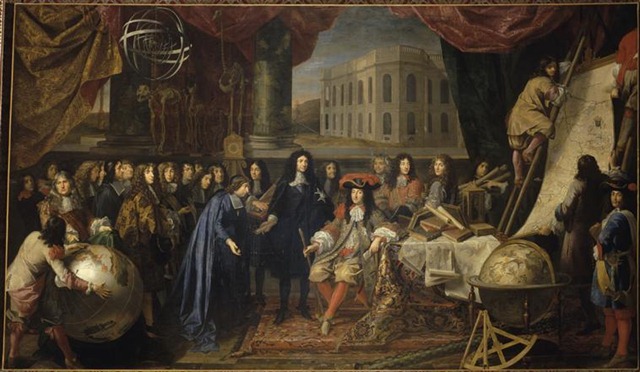
The Académie des Sciences was founded in France in 1666 only a few years after the Royal Society which formally started in 1660. It appears to have grown from the group of correspondents and visitors to Marin Mersenne. In contrast to the Royal Society it was set up as a branch of government, directed by Jean-Baptiste Colbert who had proposed the idea to Louis XIV. The early Academy ran without any statutes until 1699 when it gained the Royal label. The Academy was based on two broad divisions of what were then described as mathematical sciences (astronomy, mathematics and physics) and “physical” sciences (anatomy, botany, zoology and chemistry) within these divisions were elected a number of academicians, and others of different grades. Numbers were strictly limited: in 1699 there were 70 members and even now there are only 236. Unlike the Royal Society, funded by member subscriptions, the Academy was funded by government – giving a number of generous pensions to senior academicians to conduct their scientific work.

The Academy avoided discussion of politics and religion, echoing the founding principles of the Royal Society, and was explicit in making links to foreign academics giving them the formal status of correspondent. This political neutrality was sustained through the French Revolution: although the Academy was dissolved for a few years at the height of the Terror and was subsequently reformed with essentially the same membership as before the revolution. Furthermore work on revising the French system of weights and measures carried on through the Revolution.

The Scholarly Societies Project has an overview of publications by- and about the Academy. The earliest scientific papers of the Academy appear in “Journal des Sçavans”, which commenced publication in 1665, shortly before the “Philosophical Transactions of the Royal Society” and therefore the earliest scientific journal published in Europe. From 1699 a sequence of work is published in “Histoire de l’Académie royale des sciences” until 1797.  Finally “Comptes Rendus Hebdomadaires des Séances de l’Académie des Sciences” has been published since 1835. Most of which are freely available as full-text digitized editions at Gallica (the French National Library).

The British government established the Longitude Prize in 1714, by act of parliament, to award the inventor of a simple and practical method for determining the longitude at sea. Subsequently Rouillé de Meslay invested a similar prize for the Academy, which commenced in 1720. This sequence of Academy prizes was awarded yearly to answer particular questions and alternated between subjects in the physical sciences and subjects in navigation and commerce. Those in commerce and navigation revolved around shipping: with questions on anchors, masts, marine currents and so forth. These prizes were open to all, not just members of the Academy. Subsequently the Academy became a clearing house for a whole range of prizes, these are described in more detail in “Les fondations de prix à l’Académie des sciences : 1714-1880” by E. Maindron.

In summary, although similar in their principles of supporting science, scientific communication and providing scientific support to the state and commerce the Royal Society and the Académie des Sciences differ in their internal structure and relationship with the state. The Academy being more closely aligned and funded by the state, certainly in formal terms, and rather more limited in its membership.

In common with the Royal Society the membership records of the Académie are available to play with and in common with the Royal Society they are in the form of PDF files which are a real pain to convert back into nicely structured data. I could engage in a lengthy rant on the inequities of locking up nice data in a nasty read-only format but I won’t!

Footnotes

  • Image is “Colbert présente à Louis XIV les membres de l’Académie Royale des Sciences crée en 1667” by Testelin Henri (1616-1695)
  • *Yes, Becky, I know you don’t want me to use “scientist” in reference to people living before the term was first coined in the 19th century ;-)

References

MacTutor History of Mathematics Archive is the best English language resource I’ve found on the Académie des Sciences. Winners of the Grand Prix can also be found on this site.

Book Review: The Chemist Who Lost His Head by Vivian Grey

Portrait_of_Antoine-Laurent_Lavoisier_and_his_wife

Following on from “The Measure of All Things” my interest in Antoine Lavoisier was roused, so I went off to get a biography: “The Chemist who lost his head: The Story of Antoine Laurent Lavoisier” by Vivian Grey. This turns out to be a slim volume for the younger reader, in fact my copy appears to arrive via the Jenks East Middle School in Tulsa. As a consequence I’ve read it’s 100 or so pages in under 24 hours – that said it seems to me a fine introduction.

Antoine Lavoisier lived 1743-1794. He came from a bourgeoisie family, the son of a lawyer, and originally training as a lawyer. Subsequently he took up an education in a range of sciences. As a young man, in 1768, he bought into the Ferme Générale which was to provide him with a good income but led to his demise during the French Revolution. The Ferme Générale was the system by which the French government collected tax, essentially outsourcing the process to a private company. Taxes were collected from the so-called “Third Estate”, those who were not landed gentry or clergy. Grey indicates that Lavoisier was a benign influence at the Ferme Generale, introducing a system of pensions for farmers and doing research into improved farming methods. Through the company he met his future wife, Marie Anne Pierrette Paulz, daughter to the director of the Ferme – Antoine and Marie married in 1771 when she was 14 and he 28.

Lavoisier started his scientific career with a geological survey of France, which he conducted as an assistant to Jean Etienne Guettard between 1763 and 1767. This work was to be terminated by the King, but was completed by Guettard with Antoine Grimoald Monnet although Lavoisier was not credited. There seems to be some parallel here with William Smith’s geological map of the UK produced in 1815.

Through his geological activities Lavoisier became familiar with the mineral gypsum, found in abundance around Paris. He undertook a detailed study of gypsum which sets the theme for his future chemical research: making careful measurements of the weight of material before and after heating or exposure to water. He discovered that gypsum is hydrated: when heated it gives off water, when the dehydrated powder (now called plaster of Paris) is re-hydrated it forms a hard plaster. He wrote this work up and presented it to the Académie des Sciences – the French equivalent of the Royal Society, on which I have written repeatedly.

He was to present several papers to the Académie before being elected a member of this very elite group at the age of twenty-five, half the age of the next youngest member. Once a member he contributed to many committees advising on things such as street lighting, fire hydrants and other areas of civic interest, the Académie was directly funded by the King and more explicitly tasked with advising the government than the Royal Society was. Lavoisier was also involved in the foundation of the new metric system of measurement, which was the subject of “The Measure of All Things”. Lavoisier became one of four commissioners of gunpowder – an important role at the time. During his life he would have had contact with Joseph Banks – a long term president of the Royal Society, and also Benjamin Franklin – scientist and also United States Ambassador to France.

From a purely scientific point of view Lavoisier is best known for his work in chemistry: his approach of stoichiometry – the precise measurement of the mass of reactants in chemical reactions led to his theory of combustion which ultimately replaced the phlogiston theory. It is this replacement of phlogiston theory with the idea of oxidization that forms the foundation of Kuhn’s “paradigm shift” idea, so Lavoisier has a lot to answer for!

The portrait of Antoine and Marie Laviosier at the top of the page is by Jacques-Louis David painted ca. 1788. It strikes me as quite an intimate portrait with Marie pressed against Antoine, looking directly at the viewer whilst her husband looks at her. Marie played a significant part in the work of Lavoisier, as well as recording experiments and drawing apparatus (something that takes good understanding to do well), and assisting with correspondence and translation  she was also responsible for publishing Mémoires de Chimie after his death. She was a skilled scientist in her own right. The equipment on the table and floor can be identified: on the floor is a portable hydrometer and a glass vessel for weighing gases. On the table are a mercury gasometer, and a glass vessel container mercury – likely illustrating the properties of oxygen and nitrogen in air.

Antoine Lavoisier was executed in 1794, for his part in the Ferme Générale. His execution is attributed, at least in part to the ire of Jean-Paul Marat, who Lavoisier had earlier blocked from membership of the Académie des Sciences. It seems Lavoisier had been warned by friends that his life was in danger but appeared to think his membership of the Académie des Sciences would protect him. Ironically Jacques-Louis David also painted “The Death of Marat”.

100 pages on Lavoisier was not enough for me, I’m going for “Lavoisier” by Jean-Pierre Poirier next – some fraction of which appears to be available online, but I’m going for a paper copy.