Tag: History

Book review: Index, A history of the by Dennis Duncan

I came to indexIndex, A History of the by Dennis Duncan via a review in New Scientist. It is broadly a history of the book centred on indexes.

Duncan starts by talking about alphabetical order, and how it first came about – people have been writing their ABCs for approaching four millennia. The first catalogues or subject indexes date to the 3rd century BCE by Callimachus in the Great Library of Alexandria. The Greeks were more keen on alphabetisation than the ancient Romans. At this time writing was in scrolls, so there were no page numbers – making indexing somewhat difficult. An interesting language aside, the Greek "sittybos" was a parchment tag used to indicate the contents of a scroll from which we get the word syllabus, index is the Latin word for the same thing.

The next phase of evolution of the index was driven by the Church during the Middle Ages. Monasteries and nunneries valued reading, and the pope decreed that cathedrals should teach in 1079 which led to the creation of universities. The codex (essentially a book) had displaced the scroll as the primary format for writing by 600AD. Reading and teaching, and preaching, led to a need to find specific parts of large volumes of text hence the index.

The Bible was divided into chapters around 1200, verses were added in 1550. This is important because in the age of the handwritten manuscript pagination is variable – chapters and verses are a substitute for page numbering. Distinctios were created which drew together Bible references to make a theme for a sermon as well as more complete subject indexes, and word indexes.

A word index, or concordance, lists every occurrence of each word in a document. Here we are seeing the struggle to find the right size for an index, a concordance is too big, a table of contents, a sort of index, is not big enough. Hugh at the Dominican friary of St  Jacques in Paris produced the first concordance of the Latin bible in around 1230. The subject index is in between the concordance and table of contents in size but finding the right size is a job for skilled humans to this day.

At the same time as the Bible was being indexed and concordance-d Robert Grosseteste was creating a great index which spanned multiple books. It is always a bit difficult to determine whether historical figures have been enormously before their time, or whether an author is casting that historical figure with the present very much in mind. This struck most firmly with Grosseteste’s great index which looks to us very much like Google’s index of the internet.

Although there were a couple of experiments with page numbers on manuscript pages prior to the invention of the printing press in around 1440, it was a while before they were commonplace. Page numbers are a bit awkward to print because they fall outside the main body of the text, so there was some experimentation with using the folio marks used by the printer to compile a book properly. Sometimes in the 15th century readers were instructed to write the page numbers into the index themselves!

A recurring theme is whether reading an index is "cheating", whether it takes away from the activity of reading fully a book. Duncan also cites Socrates’ Phaedrus where it is argued that speaking is superior to writing/reading. We see a similar argument today as to whether Google has replaced our ability to read. Thinking of my own reading of non-fiction, I don’t make much use of indexes but I do have an Evernote of books like this with page number references – as you can see here – I use them when writing these reviews, so in a sense they are my own index.

In the 17th century the index as satire was invented, it was a time when political pamphlets were all the rage, and a format was found for the satirical index. I was entertained by the story of William Bromley, and the election to Speaker of the House in 1705. Just prior to the election his enemies published an index of his travelogue Remarks in the Grand Tour which cast him in a poor light, highlight errors of fact, statements of the obvious and hints of popery. He subsequently lost the election.

A genre I’d never seen before is the fictional index, that is a work of fiction which features a fictional index or even a work that is entirely a fictional index such as Nabakov’s Pale Fire or The Index by JG Ballard. Erasmus started this in 1532. Although there were experiments with indexing fiction, ultimately these never really took off.

Universal indexes in the manner of Grossetestes’ made something of a return in the 19th century, with Jacques-Paul Migne’s collected works of the Church Fathers. Later in the century there was an abortive attempt to index everything stemming from J. Ashton Cross’s presentation to the Conference of Librarians in 1877. A longer lasting effort was William Poole’s An Alphabetical Index to Subjects Treated in the Reviews and Other Periodicals perhaps this worked because its scope was smaller.

The final chapter covers the impact of computers on indexes, so far computers have been more dumb companions rather than creators in making indexes. They are able to generate concordances very quickly but even the best software struggles to identify appropriate subjects: what to index and what not to index. The problem is that computerised search provides and adequate index, so publishers are less inclined to spend money on an index – which is a separate, specialised activity to the authoring of a book.

I was worried that a history of the index would be a bit dull but I really enjoyed this book.
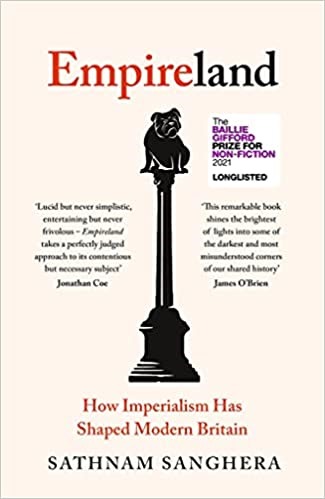
Book review: Empireland by Sathnam Sanghera

empireA return to reading about race with Empireland by Sathnam, subtitled How Imperialism Has Shaped Modern Britain. I think the best way of thinking about this book is as a perspective on the British Empire and its impact on present day Britain by a British Sikh. Although the coverage is global there is a focus on India, which reflects Sanghera’s background. I’m used to reading history by white British or American authors, so this is a refreshing change.

The signs of Empire are all around us, not least in the multicultural, multi-ethnic society we find in Britain which impacts our food, our religious observances and our art. A range of quintessentially British companies had their origins in the trade with India such as Shell who originally sold shells from India! Or Liberty original founded for the India trade. There are also a range of processed foods which were developed for the empire, to remind the colonists of home or taken up following colonial origins (rum, pale ale, madeira, gin and tonic). There is some argument that our welfare state had its origins in Empire, in providing "men fit to fight" which was a concern after the Boer War. We also borrowed a significant number of words into English from the empire: bungalow, shampoo, zombie, toboggan… 

The Empire, and Imperial history is not clear cut, there are two very broad phases – the American and contemporary phase and the 19th century India and Africa phase. The Empire was not the result of a strategic plan, or governed in a unified manner, in contrast to the Roman Empire. As John Robert Seeley said: "We seem, as it were, to have conquered and peopled half the world in a fit of absence of mind". It seems also that the Empire was not front of mind for the British public for almost its entire span, in the days before a global media with relatively few British people involved with the Empire in Britain or even in the Empire this is perhaps unsurprising.

A recurring theme is how British actions in the empire were criticised at the time, on issues like the Jallianwala Bagh massacre, and the looting of Tibet. Key figures in the Empire, like Robert Clive and Cecil Rhodes were similarly criticised. The rehabilitation of Edward Colston is a case in point – he was not greatly celebrated during his life and the subscription to raise his statue some 200 years after his death was not filled. It is only with the recent en-harbouring of his statue that he has gained support. History that seeks an unalloyed positive view of the Empire just isn’t history. 

Looting gets a whole chapter of its own, it focuses on the case of Tibet which was invaded by the British in 1903/4 – interestingly the invasion was commonly referred to as the "British Expedition to Tibet" or the "Younghusband expedition to Tibet" – note the rather passive language. It is clear that looting was seen as part of military operations and was formalised. There is a degree of greyness in the process since troops were on occasion censured for looting, and there were budgets for the purchase of artefacts. However, there were clear processes for the handling of artefacts looted during invasions and the sums set aside for purchasing artefacts were completely incompatible with the amount of loot returned to Britain. In Africa human body parts were taken by British soldiers as trophies, something which caused disgust in Britain at the time.

The sad thing is that most of the looted artefacts in British museums are not actually on display, and in the more distant past they were scarcely valued at all. Sanghera points out that the British establishment finds it impossible to return looted artefacts from British museums to their rightful homes but has quite the opposite attitude to people with established lives and families, as long as their skin is dark.

Immigration was often at invitation, citizens of the British Empire were just that but whilst white members of the Commonwealth have always had a welcome in Britain, those of colour have not. Conversely Britain has a large emigrant – outbound – population. It is part of the deal. Sanghera writes a bit about Britons abroad, the Brit transplanting their lifestyle to Spain is seen as a continuation of the colonial times.

Sanghera talks about racism and white supremacy in the British Empire. This is pretty explicit, the leading figures in the Empire were very clear that they saw the white British as superior and indigenous populations as naturally inferior, in need of the firm hand of white rule. White rule, sometimes meant massacre or even genocide, as was the case for the indigenous Tasmanian population.

Sanghera ends on a somewhat positive note, although Britain is not at the forefront, countries like Germany, France and the US have started talking about the return of looted artefacts, reparations for slavery, and some degree of contrition for their actions during their colonial period. The British government is trailing in this, although the public Black Lives Matters protests, and private initiatives to return looted artefacts, and discuss more frankly our troublesome past are taking place.

I think this was a useful step on my journey in understanding my country, and all the people that live here.

Book review: Precolonial Black Africa by Cheikh Anta Diop

diopMy next book follows on from reading Black and British by David Olusoga. It is Precolonial Black Africa by Cheikh Anta Diop. I was looking for an overview of African history from an African perspective. Diop’s relatively short book focuses on West Africa. It turns out he is a very interesting figure in himself, building several political parties, doing research in history as well as physics and chemistry and having a university named after him. Some of his ideas on African history are controversial (you can see the wikipedia page relating to him here).

The core of the controversy is two fold, one is his claim that ancient Egyptians were black, and the second is that there is a historical unity in West Africa civilisation with migration from the east of Africa populating the continent. The basis for this thesis relies quite heavily on similarities in totemic names across the region as well as cultural similarities. These days there is some support for the migration of populations out of the Nile basin to West Africa from DNA evidence.

Most of the discussion in this book is oriented around the area of West Africa where Diop grew up, in Senegal, with some mentions of Eygypt and Sudan. Diop draws parallels in the internal organisations across the empires of Ghana, Mossi, Mali and Songhai. The Empire of Ghana stretched beyond the boundaries of the modern country, and stood for 1250 years. Mossi was to the east and south, in the area of modern Burkino Faso, Mali and Songhai were a little to the north encompassing the modern Timbucktu. Looking at wikipedia these empires appear to have overlapped to a degree both in time and space. Precolonial Black Africa covers the period from about 300AD to the 17th century although it does not make much reference to dates.

There is almost no mention even of the area of Nigeria, a little to the east, or Southern Africa. I was nearly half way through the book before I realised that Sudan referred to two different places: Sudan the modern state in North East Africa, and the Sudan Empire which stretches across the southern margin of the Sahara in the West of Africa.

The books starts with a description of the caste system, emphasising the two-way nature of the system and contrasting it to a degree with the caste system in India.

Precolonial Black Africa contrasts Africa with Europe, in the period covered by the book Europe was based on city-states which evolved into feudal structures, with Roman geographical divisions, where defence from marauders by the lord in the castle was important. Land ownership was core of this political system whereas Africa evolved more along Egyptian lines which saw countries divided into regions with regional governance and no tradition of land ownership.

These empires were led by kings with a small cabinet of advisors who had both a regional responsibility and a specialism (like a minister for finance, or the army). Although not republics, nor democratic in the modern Western sense, Diop claims that these governments were more representative than their Western European equivalents of the time.

The technological expertise of the ancient Romans and Greeks was carried through the Middle Ages by the Arab world. It is no coincidence that Spain was once a technology leader, given the Muslim rule of Spain. Islamization of West Africa is a recurring theme of the book, and Arab writers feature regularly in the lists of sources for the early history of Africa. Islam was important in education through to the present day, this is in part responsible for slowed technological progress in the region. Islamic schools did not place a great emphasis on what they consider pagan history, nor so much on modern science.

Precolonial Black Africa covers technology relatively briefly, mentioning architecture and the Great Zimbabwe – a significant stone-built city in present day Zimbabwe whose early excavation was plagued by the then Rhodesian governments view that it could not be constructed by Black Africans. Coins, and metalworking are also mentioned – West Africa made relatively little use of the familiar coinage of European. Gold dust was used as currency, as were Cowrie shells. The Benin Bronzes dating from the 13th century demonstrate there was significant metalworking skill in West Africa (the Bronzes are currently in the news as the UK refuses to return them to Benin). Little of technology and writing seems to have survived from precolonial times, I suspect this is a combination of the environment which is not conducive to the preservation of paper (or even metal), successive colonisations by Islam and then Europeans and relatively little archaeological activity.Trade seemed quite significant across West Africa, even in the absence of conventional coinage.

The interesting thing reading this book is the contrast with flaws that Western history has had in the past, being focussed on great men, the idea of the natural superiority of the white man, and leaning heavily on Classical heritage for legitimacy. I suspect these points of view are generally not prevalent in modern academic history but they certainly hold sway with the current UK government and a coterie of right-wing historians. To a degree Diop suffers the same types of prejudices but from a different perspective – the superiority of the Black African. My view of African history is still heavily influenced by those old Western European foundations.  

After a rocky start I came to enjoy this book, I found the book alien in a couple of respects firstly in its discussion of history from an African perspective, and also simply that it is African history. What I know of Africa is largely through a colonial lens. 

Book review: Ancestors by Professor Alice Roberts

ancestorsSomewhat unintentionally my next book, Ancestors by Alice Roberts, follows on from Hidden Histories by Mary-Ann Ochta and The Goddess and The Bull by Michael Balter. Ancesters is an investigation of the transition from early Stone Age people in Britain through the Neolithic, to the Bronze Age finally the Iron Age through the medium of seven burials around Britain. As well as the facts of various burials Roberts talks too about in archaeological methodology over time.

The broad context of the book is a project on recording ancient DNA in which Roberts is involved, a project on hold due to covid. Motivation for this is that we can observe the movement of ancient peoples and relationships between people in burials using DNA. These techniques have not been applied extensively to Neolithic remains to date.

The first burial discussed is of the "Red Lady" in a cave in the Paviland Cliffs on the Gower in Wales. It dates back to the Paleolithic (old Stone Age), 34,000 years ago and is the oldest burial discovered in Britain, from a period before the last Ice Age. William Buckland was the first to scientifically describe the burial, and his descriptions reflect the opinions of the time. He sought to reconcile such burials with biblical knowledge, and social mores, initially describing the burial as of a "Red Lady" because of the decorative grave goods (and the body being caked in red ochre). It turns out the burial is actually of a man!

As far as we can tell deliberate burials by homo sapiens date back about 100,000 years. The evidence is mixed as to whether Neanderthals practiced burials. This rubicon is seen as important since burial rites represent a move to modern human thinking which distinguishes us from other animals (so far!). I particularly enjoyed the description of the "flower people" where, in a burial in Iraq, it has never been quite clear whether Neolithic people buried people in flowers or whether it was actually the work of gerbils that, by the way, also gnawed on the body.

Returning to UK we meet Cheddar Man, who was buried after the last Ice Age about 10,000 years ago. Incidentally we learn how to wind up an anatomist with fake skeletons: in real life the pelvis and ribcage of a skeleton collapse because the ligaments don’t hold them together after they’ve been in the ground for a bit – fake skeletons don’t show this. At 14,700 years old other skeletons in Gough’s Cave, where Cheddar man was found, are the earliest post-Ice Age human remains found in Britain.

Cheddar Man was from the Paleolithic or old Stone Age, the next burials discussed are from the Neolithic or New Stone Age. The defining feature of the New Stone Age is the move from hunter/gathering to agriculture and settlement. The key question is whether this change in behaviour was a transmission of ideas, or an influx of people with these new habits. This transition to agriculture 11,000 years ago is one of the central themes of The Goddess and The Bull, in Britain the transition takes place a later – about 6,000 years ago.

Farming arrived in Britain with people, rather than just ideas. There’s evidence of violence in some of the burials discovered (about 10% of skulls show signs of traumatic injury) but as far as can be ascertained this was farmer/farmer violence rather than hunter-gatherer/farmer violence. It seems that hunter-gathering died out with its practitioners rather than its practitioners converting to farming. Something that I hadn’t heard of before was the idea of a "house burial" – some Neolithic burial barrows are on the site of dwellings, longhouses, which have been ritually burnt. Neolithic burial sites are often reused in the Bronze and Iron Age, perhaps to maintain contact with the land. Perhaps burial becomes more important once we start to stake a claim on particular pieces of land.

There’s a small diversion at this point to discuss Pitt Rivers, a 19th century archaeologist whose methodology was beyond his times in the sense that he made meticulous records of what he had dug. He was born Augustus Lane-Fox but changed his surname to Pitt Rivers as a condition of receiving a substantial inheritance. He spent his later years in detailed excavation of his inherited Rushmore Estate which lies close to Salisbury and is incredibly rich in archaeology (or perhaps if you are rich, an archaeologist and inherited a large estate it turns out there is a lot of archaeology you can do).

Next we move to Bronze Age burials, where things get exciting in terms of grave goods. Starting gently with some arrows and so forth we move on to whole, upright chariots including the horses in the Iron Age!! The Bronze Age is also marked by an influx of people. I recall from my Seventies childhood the Beaker People (identified by a particular type of pottery).

At this point, in the late Iron Age we transition from prehistory to history with Roman writings on Britain. Such records need to be treated with a little care since they are often second hand and are the viewpoint of a conqueror. It is interesting to see the names of Iron Age tribes carried forward to the present day, for example in the Parisi in Northern France (turning into Paris) and Durotriges turning into Dorset.

Roberts notes at the end of the book that burial practices don’t have to be universal across a period we consider to be discrete such as the Bronze Age, to the people living at the time they were not "Bronze Age" they were people of a much narrower place and time. Large changes in burial practices are not necessarily indicative of religious changes – Britain shifted from burial to cremation from the end of the 19th century to the Sixties with no change in religion.

The writing of the book stretched into the covid pandemic, it is an interesting mix of topics written in an engaging style. There are a couple of places where the editing slips a bit. Overall I found it an engaging read.

Book review: The Goddess & The Bull by Michael Balter

the_goddess_and_the_bullI like to vary my reading, so from my previous review on guitar riffs we go to Neolithic archaeology, specifically the archaeology of Çatalhöyük in The Goddess and The Bull by Michael Balter which carries the subtitle "Çatalhöyük – An Archaeological Journey to the Dawn of Civilization". Çatalhöyük featured in a recent TV programme "Raiders of the Lost Past with Janina Ramirez" which I recommend if it is still available – this is what prompted me to get this book.

Çatalhöyük, in Turkey, is a prehistoric township which was active between 7500BC and 6200BC, it reached a peak size of some 5000 residence and as such it notable for being one of the largest of the early Neolithic settlements.

The Goddess intertwines several themes, it provides some biographical detail of the key archaeologists involved in the dig, it talks a bit about the evolution of archaeological methodology, and it talks about what was found at Çatalhöyük and the wider human activity in the Neolithic period. This is laid out in chapters that proceed chronologically with each chapter mixing elements of biography, methodology and the Neolithic period.

Any story of Çatalhöyük starts with James Mellaart, the first archaeologist to dig the site in the early 1960s. It’s fair to say he was a bit of a character. When he arrived in Turkey in the 1950s the Neolithic remnants were little known and he discovered hundreds of sites in his tour, on foot, of the area. These were largely in the form of "tells", large mounds built of successive layers of settlement made one on top of another. Çatalhöyük stood out because it was large, and it was early Neolithic from top to bottom. Many of the tells were occupied over very long periods of time so the earliest archaeology was obliterated by the later.

After digs at Çatalhöyük between 1961 and 1965, Mellaart was banished by the Turkish authorities following accusations of facilitating the sale of archaeological artefacts. His case was not help by the "Dorak Affair" in 1958 in which a mysterious woman showed him a range of artefacts from the Neolithic which he dutiful wrote up in various articles – these artefacts never saw the light of a museum and the Turkish authorities suspected Mellaart in their disappearance. The mysterious woman has never been found. Over the rest of his life Mellaart continued to publish on Çatalhöyük, later articles becoming somewhat fanciful.

I found it striking how much of the archaeological work done in the Middle East was done by British, American and other Western European archaeologists, often with their own institutes in-country. It feels like a water-down version of the bad old days of the 19th century where Europeans pillaged the countries of the ancient world for artefacts, although it is clear these 20th century ventures were much more under the control of the "home" countries.

Also relating to politics, the book highlights how much modern archaeology is funded as rescue work, during the construction of roads and railways in the UK, and frequently dams and hydro-electric schemes in the Middle East. In the nineties phase of digging at Çatalhöyük, Ian Hodder, the director of the work, spent a lot of time fundraising from both public and commercial sources.

From a methodological point of view, Mellaart’s first archaeological digs were based on the vertical stratigraphic approach borrowed from geologists which had been made popular in the forties and fifties by Kenyon and Wheeler. Here layers of a site are stripped back successively to establish a chronology, aiming for depth rather than breadth. This replaced the 19th century approach of broad area excavation where discovering the horizontal extents of a site was the priority, as was the discovery of "treasure", I suspect. Following Mellaart’s excavation the "New Archaeology" arose which became the "Processual" movement in which the emphasis was on highly detailed digging and analysis with a view to testing hypothesis. Earlier schemes being more interested in cultural artefacts. In a nutshell, the processual view saw different forms of stone axes representing different uses, whilst the previous view saw different axes as representing different cultures.

Ian Hodder represented a further evolution in methodology, post-processualism which included the intensive specialist sampling of the processualists but added more context from sociology and anthropology, and even the subjective feelings of the archaeologists as they worked. Pierre Bourdieu, a French sociologist and a bête noire in our household, is mentioned! Hodder took over the excavation of Çatalhöyük in the earlier nineties, and continued through to the completion of this book in 2006, and beyond until 2017 when digging seems to have stopped at Çatalhöyük.

The core question around the Neolithic era was what made Palaeolithic hunter-gatherers settle and take up farming, and how did they do this. There is some evidence that settling, living in permanent villages occurred some time before farming started. But why did farming start? Why did settling start?

There isn’t really a conclusive answer to this. Çatalhöyük, as a substantial Neolithic settlement, is pre-dated by a short spell by sites such as Jericho. It is comprised on many relatively small dwellings with common features: evidence of a ladder and an oven on the south wall, indicating access from the roof, numerous human burials under the floors. There is no evidence of specialist or communal buildings or a social hierarchy. The walls of the buildings were decorated, sometimes with bulls’ skulls or vulture heads inside them. It seems that buildings were ritually burnt at the end of their lives, typically after one hundred or so years of occupation. The people ate cultivated crops, and domesticated sheep and goats and some wild cattle, more of the wild cattle during what appear to have been ceremonial meals.

One theme from the sixties epoch of excavation that didn’t make it through to the nineties was the idea of Goddess worship, in the sixties there was some enthusiasm for the idea that Çatalhöyük represented a matriarchal society which worshipped a goddess. This idea does not seem strongly supported by the archaeology, although there are a number of "goddess" statues discovered they are all small and not found in particularly salubrious situations. There is more evidence for the idea that the bull was venerated – I wonder about the links between this and the position of cows as sacred animals in Hinduism, and also its role as a pictogram that evolved into the letter "a".

I really enjoyed The Goddess and The Bull, having approached it somewhat sceptically because it was not the recommended book by experts (James Mellaart: the journey to Çatalhöyük by Alan Mellaart) and it wasn’t clear whether it was an intensely academic volume. The biographical material of the archaeologists is sometimes a little grating but it makes the book more readable. I felt I learnt a lot about archaeology and the Neolithic. There’s a website www.catalhoyuk.com, where you can see the latest developments – including annual reports up to 2017.