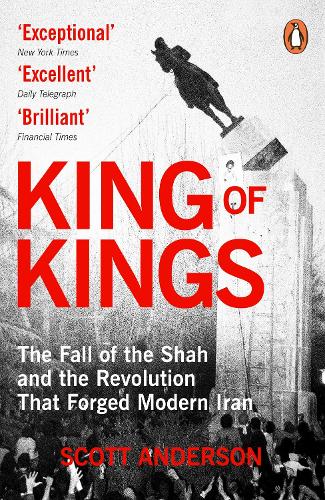
Another result of browsing in a bookshop, this review is of King of kings: The Fall of the Shah and the Revolution That Forged Modern Iran by Scott Anderson. For readers of the future – this review was written in April 2026, two months into the what is currently called the “2026 Iran War“.
King of Kings covers the run up to the Iranian revolution in 1979 mainly focussing on the 1970s and ends with the release of the American Embassy hostages in January 1981. The acknowledgements talk about the aim of the book being to capture the Revolution from the point of view of those involved through interviews with them. The book was published in 2025 and those interviewed are in their late seventies and older now.
I think it is inevitable that the focus is on American participants – Anderson specifically calls out Michael Metrinko and Gary Sick as key contributors. Sick was a member of the National Security Council under President Carter, and was the principal White House aide focused on the Persian Gulf. Metrinko was the US consul in the Iranian city of Tabriz in the run up to the Revolution and was one of the US Embassy hostages. However, Anderson also spoke with the Shah’s Queen, Farah Pahlavi who is still alive.
From the revolutionary side, those surrounding Ayatollah Ruhollah Khomeini – the spiritual leader of the revolution – there is relatively little. Ebrahim Yazdi, one of his closest advisors, gets a chapter and is referenced throughout the book.
King of kings is divided into three parts: the first titled “Towards a great civilisation” provides some background on Iran and the Shah – leader of Iran from 1953 until the 1979 Revolution; the second “The Unravelling” covers the build up to the revolution, mainly in 1978 and “Downfall” covers the revolution itself from the end of 1978 through to the return of the US embassy hostages in January 1981.
The Shah claimed a dynasty for Iran going back 2500 years, in fact one of the key events in the early part of this book was an extravagant celebration of this anniversary at Persepolis. Iran lay at the collision point between the the expanding British and Russian Empires in the 19th century, oil was discovered in 1908 and largely signed away to the British by the ruling Qajar dynasty. During the First World War Iran was a battleground for Russian and German forces, in the process 2 million Iranians died. In the Second World War Iran sought an accommodation with Germany which worked fine until Russia and Britain joined forces to invade Iran; they deposed Reza Khan, the Shah’s father in 1941 and installed him (Mohammad Reza) as monarch.
In the post-war period the country was governed by the Prime Minister Mohammad Mosaddegh who introduced a range of social reforms, and nationalised the oil industry much to the chagrin of the British and Americans who deposed him in a CIA backed coup in 1953 re-instating Mohammad Reza as an absolute monarch.
The Shah ran the country as a dictatorship although he introduced a large set of social reforms in his 1963 White Revolution which upset more conservative Muslims such as Khomeini.
Iran as a country became very wealthy very rapidly in the seventies as a result of the Shah nationalising the oil industry, and OPEC starting to exert itself (1973 is a key year here). At the same time the US essentially entirely opened up arms sales to Iran and the Shah was a very willing customer. But the wealth was very unevenly distributed, Iran urbanised rapidly bringing many young men into cities not prepared for them. These young men were often conservative from a religious point of view.
There had long been opposition groups in Iran but they were subject to arrest, violence from the secret police (SAVAK) or, like Khomeini, exile. Khomeini had been living in Iraq but Saddam Hussein was becoming increasingly unhappy with his presence and he fled to France in October 1978. This turned out to be a fortuitous move because he was much more able to hold court with Western journalists there with his lieutenants he was able to present a (completely fake) moderate face.
It’s difficult to pinpoint a point at which the revolution started, Iran is a Shia majority country and offers a wide range of dates for public displays of mourning which could be readily repurposed to rioting. This started happening with increasing frequency and surprising precision from the start of 1978 following a government sanctioned news paper editorial attacking Khomeini. Precision because very particular businesses and institutions were targeted by well-disciplined rioters. I think this is part of the story is missing something, it seems clear there was significant organisation on the ground of the revolutionary forces and there is no real indication of Khomeini being very actively involved in this.
The Revolution, when it came, followed the departure of the Shah from Iran on 16th January 1979 – having installed Shapour Bakhtiari as Prime Minister – an opposition leader of long standing – with a view to arranging a moderate post-revolutionary government. Ayatollah Khomeini returned to Iran on 1st February 1979. Outside of Iran he had been making moderate noises but on his return to Iran he resumed his theocratic radicalism, sacking the recently installed Prime Minister and adding his own. The army mutinied in favour of Khomeini’s forces. A number of senior figures from the previous regime were summarily executed within a month of Khomeini’s return. He then set about making a constitution that handed power entirely to clerics (and ultimately himself).
There was possibly a space for a more moderate government but that ended with the US embassy hostage crisis and the US’s botched rescue attempt. The Embassy had been invaded by radical university students and it is not clear whether Khomeini had sanctioned the attack but in any case he supported it once done. Also unclear is whether Ronald Reagan’s campaign team had influenced the Iranians to delay the release of the hostages – it seems very plausible – they were released on the eve of Reagan’s inauguration. Interestingly the Revolutionary Iranians were keen to do arms deals with the Americans since they had a large quantity of US military hardware and needed consumables resupply.
Anderson’s conclusion regarding the Revolution was that the Shah seemed strangely inert as the revolution approached, attributing this to him being a dictator but not of the sufficiently brutal, bloodthirsty type to put a stop to opposition. In common with all dictators he ended up surrounding himself with people that only agreed with him. I can’t help thinking his deteriorating health played a role – he died at the age of 60 in 1980 having fled Iran in January 1979, he had been fairly seriously ill for several years but kept it secret even from his wife.
The US was almost completely oblivious to the tide rising against the Shah, very few of their embassy staff spoke the local language (Farsi) and they were discouraged from speaking to any sort of opposition to the Shah. They were also doing good business with Shah for military hardware, and saw him as a moderate bastion and ally in the area. As the revolution unfolded the institutions of the US government were fairly actively fighting each other.
I found this gripping reading, partly because of its current relevance but also because it is well written. It is clear that the American focus does not capture the internal workings of the revolutionary forces very well but I suspect that is still a hard problem even now, for Middle Eastern writers.