
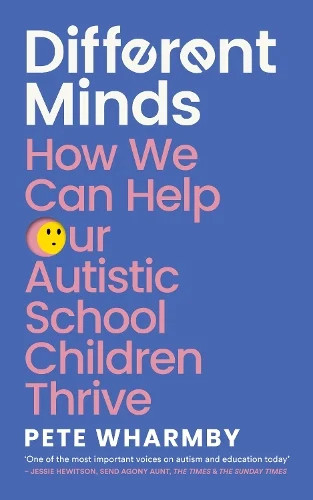
My next review is of Different Minds by Pete Wharmby, it has the lengthy subtitle “How can we help our autistic school children thrive”. I read Wharmby’s Untypical, about a year ago when my son was at online school as a result of Emotionally Based School Avoidance and one year into the waiting list for an autism assessment. One year on, he has just received his autism diagnosis.
Different Minds is divided into 10 thematic chapters entitled How did we get here?, The Mornings, The School Day, The Learning, The People, The Classroom, Socialising, The Behaviour, The Assessments and The Collapse.
Chapters usually start with a quote, a vignette from the life of Joe – an emblematic autistic child, and some bullet points on what is covered in the chapter.
Wharmby describes in the introduction that autistic people are “sparrows living in a world built by moles” which I think is rather beautiful. Neither sparrows nor moles are malicious but their views of the world are utterly different. This is the double-empathy problem, not only do autistic people not understand non-autistic people – the opposite is true too.
The overarching theme of the book is that the school routine as it is currently configured leaves autistic children in a state of almost continuous stress which leads to higher rates of anxiety and depression. These are not an intrinsic part of the autism diagnosis they are a result of the stresses of living in a world not built for autistic people. The proposals for schools and parents in this book are about reducing that stress.
Autistic children are a puzzle for teachers because they are different from their non-autistic peers, Wharmby went through teacher training in 2008 and had just a one hour session on autism. As an example of a teaching related difference, autistic children may have “spikey skill sets” – typically a child good at one subject will be good across a wide range of other subjects but an autistic child might not, furthermore they may be competent academically but unable, for example, to tie their shoelaces.
Wharmby recalls that the first autistic child he taught had notes of “bites other children” and “threw a chair” against his name when he received him into his class. This set his expectations for teaching that child – this is known as anchoring bias. The child turned out to be fine in lessons with Wharmby.
It may be that autistic children complain of the classroom environment because they are unusually sensitive to noise, light, smells, heat, cold and so forth; quite possibly they are finding their uniform very uncomfortable. Often on complaining they are told “Don’t be daft” but these are very real sensations for them.
It goes without saying that if teachers struggle to empathise with autistic children, through lack of training, then their classmates will face an even bigger challenge which can lead to isolation and bullying.
At one point Wharmby ponders whether autistic people fall into the “uncanny valley” for non-autistic people. Autistic children may struggle with appropriate eye contact, small talk, body language, minimal sharing of personal information turn taking, saying goodbye which marks them out as different.
We talked a bit about this as a family and wondered whether that was rather offensive but perhaps gave an insight into how other people interact with autistic people. An observation I made of my probably autistic father, and myself is that we are more charismatic than we give ourselves credit for – perhaps because social interactions are something we have to work hard at. This does not tally well with Wharmby’s account where he says that autistic children can be isolated by their peers and prone to bullying; although he mentions that becoming the “class-clown” is one way autistic children cope.
The very structure of the school day can be a struggle for autistic child who may exhibit monotropism – focus on a single topic – rather than switching between lessons every hour. Autistic children would benefit if their broader education could be linked to their special interests.
Interestingly Wharmby says autistic people often “get it wrong” when trying to empathise with someone by relating similar experiences to their own, apparently it makes it “about you”. This is news to me, if I’m talking to someone who has lost a parent then I’d probably mention somewhere in the conversation that my dad died a few years ago as an indication that I had some insight into how they were feeling – obviously I wouldn’t lead on this piece of information.
On assessments Wharmby talks about Rejection Sensitivity Dysphoria (RSD) – basically a very strong reaction to criticism often coupled with a struggle to accept praise. Following his guidance I will say that the vignettes of Joe’s school day in the book are a very powerful and compelling technique.
In the final chapter “The Collapse” Wharmby talks about how schools are the number one cause of burnout because of their obsession with attendance – I absolutely agree with this. He distinguishes between a meltdown which is a one off event (although autistic children attending school may have one every day), and burnout which is a longer term utter mental and physical exhaustion.
I found Untypical a bit of a harrowing read and I have to say the same of this book, Wharmby has a nice writing style but the continual state of stress and anxiety he describes for Joe, his emblematic child, is oppressive.
The intention of Different Minds is in part to understand how autistic children experience school but then to change schools to make them more tolerable. I must admit I came away from the book thinking that if school is only half as bad for my son as described in the book I should take him out immediately. Change happens slowly in schools, and whilst the Department for Education may pay lip service to making schools “inclusive” they are still very focussed on attendance and they seem to have more of an eye to cost and the status quo than the needs of autistic children.
To answer the question posed in the lengthy subtitle I fear the answer is “Take them out of mainstream schools”.