

My next review is of Symbols and Allegories in Art by Matilde Battistini which I discovered is part of a series: Guide to Imagery which looks interesting. I found this book by searching because I was interested in understanding more about allegories in art. I knew from watching various TV programmes that there was more to paintings than their surface appearance.
Symbols is divided into an introduction, and four sections on Time, Man, Space and Allegories, each of which describe twenty or so items. Each entry describes the linguistic and mythological origins of a term and is illustrated with at least one painting or sculpture with parts of the artwork labelled. Sometimes subsequent pages show more related artworks with labels.
Most of the paintings are from the Medieval and Renaissance periods but there are some artworks from the 19th and even 20th century. I think they are all from Western Europe presumably the allegorical language elsewhere is different.
Allegorical content in artworks evolved over time, in the Medieval period it was very much about good and evil, focussed around the Christian faith. Much of the iconography of early Christian art was based on earlier mythology. During the Renaissance there was a greater direct focus on Classical themes and mythology. Later the use of allegories was codified into documents – it was a pity not to see references to an example of this. Within Christian iconography there is an evolution from the Medieval period.
I think this book is intended for the somewhat expert in art history, it doesn’t talk about why allegories appeared in paintings and who made art for whom.
In many cases the paintings helpfully contain the word “allegory” in the title, so the reading is not as blind as you might think.
Since there are a limited number of sections each section is quite broad, so the section on time includes seasons, months, times of the day, ages of man and the world and items representing the flow and circle of time.
The Seasons appear early in the book and are a good illustration of how sets of things are represented allegorically. The seasons are associated with different phases of human life birth (spring), maturity (summer), decline (autumn) and death (winter). They are also associated with animals (ram, lion, bull and snake) and gods (Zeus, Helios, Dionysus, and Hades) in Greek mythology. Seasons can also be represented by women, we can identify which season by their headwear – Spring is represented by a woman with a crown of flowers, Summer with a crown of wheat stalks. More widely figures are recognised by the objects they hold or are close to, Saturn for example is shown as an older man carrying a scythe or hourglass.
The section on man contains entries on key biblical figures like Christ, the Virgin Mary, Eve, the Trinity, angels and Satan. As well as a range of monsters of different types. There are also what seem like miscellaneous entries on eggs and mirrors. The idea of the Trinity was created in 325AD at the Council of Nicea; angels only gained wings in art in the 4th century AD and that the iconography of the Virgin Mary derives from earlier gods such as Artemis and Isis. I was interested to learn that haloes come from Indo-Iranian deities via Roman and Byzantine emperors before reaching Christianity.
One of the pictures for the Monsters entry is Piero di Cosimo’s, Perseus Frees Andromeda which features members of the Medici family – a hidden meaning not otherwise covered in the book.
The section on space covers the astronomical (sun, sky, cosmos, moon), the earthly (garden, mountain, forest, tree) and the religious (Heaven, Hell, Purgatory, Limbo). Dante’s Divine Comedy, completed in 1321, is cited a few times as a source for depictions of Hell, Purgatory and Limbo. The representations of Hell stabilised in this period.
The final section on “Allegories” is a bit different from the others, it covers items like The Senses, The Virtues, The Vices but there are rather fewer items than in the earlier sections but each is illustrated by more examples. Love is included in this section where we learn the parrot is a symbol of lust! Young women represent the cardinal virtues: fortitude, prudence, justice and temperance and the theological virtues: faith, hope and charity. The cardinal virtues derive from ancient Greek philosophy whilst the theological ones are medieval.
I must admit this book got me thinking about data. Is there a global database of paintings? How often does “allegory” appear in the title? And the somewhat off-topic question of what fraction of the paintings made in any particular period / place survive?
I found this book interesting and readable although I was expecting more on the framework into which allegorical depictions lay. The parent series definitely seems worth a look.
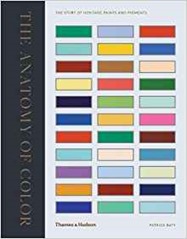 The Anatomy of Colour