
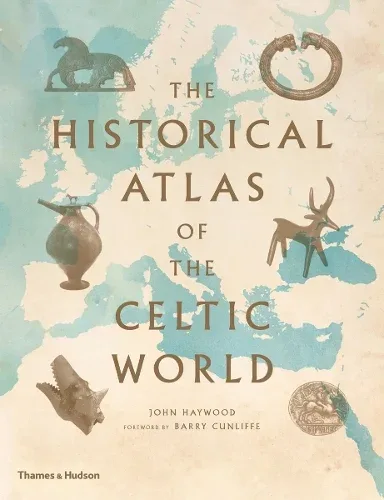
My next review is of The Historical Atlas of the Celtic World by John Haywood, bought in the same spending spree as Ancient Rome Infographics by Nicolas Guillerat, John Scheid and Milan Melocco. The two books are from the same publisher, Thames & Hudson, and were promoted together but they are quite different. I have to say I prefer this book, the graphics are less varied but the story comes through more clearly than Infographics.
The Historical Atlas is divided into 3 parts: The Continental Celts, The Atlantic Celts (Britain and Ireland) and The Modern Celts. Each part starts with a few pages of introduction followed by double page spreads on a range of topics – often a date range for the action is included. Typically these spreads will comprise a map, and some photos or diagrams. Overall it is a well-illustrated book.
The Celtic World is defined by Celtic languages including languages from Gaul (France), Italy and the Iberian peninsula that have long gone extinct. It once spanned central and Northern Europe, from the North of the Iberian Peninsula, across Northern Europe (including the Great Britain and Ireland) all the way to the Black Sea. Genetic evidence suggests origins as far back as 6000BC but the first archaeological evidence goes back to 800BC with the Hallstatt and La Tène cultures. Now all that remains is Ireland, Wales, Scotland, Cornwall, Brittany and Galicia in North West Spain – largely as a result of a revival of Celtic culture starting in the 18th century.
In terms of settlements, hillforts were popular across the Celtic world, as well as oppidum – fortified lowland towns. The British were nearly unique in preferring roundhouses over rectangular buildings found in the rest of Europe. In the North East of Scotland brochs (fortified towers) and duns (small forts) were popular in the later ancient period (500BC-200AD). It was only as the Roman Empire expanded that parts of the Celtic World started to urbanise.
Trade was long a feature of the Celtic World, going all the way from Ireland into the rest of Europe. As contacts with the Roman Empire increased, local Celtic leaders developed a taste for luxury goods. In exchange Romans took chain-mail, barrels, shipbuilding techniques and legionaries helmets from Celts – the Celts were not technologically backward.
Druidism was an important part of Celtic culture, it was not popular with the Romans since it purportedly involved human sacrifice, although it might be wise to take Roman writings on Celts with a pinch of salt – they were trying to justify invading them.
The first written records of Celts date to 600BC by which point they dominated Western and Central Europe. They sacked Rome in 390BC, and made in-roads into Greece for 20 years from 300BC amongst other invasions to the East, these rarely left any archaeological record. The Celtic civilisation was not centralised in the manner of the later Roman Empire, it was a looser confederation with a shared culture rather than power. This meant that when the Roman Empire expanded it was faced largely with smaller battles against isolated tribes and leaders rather than facing off against another empire.
The Roman’s took over the Celtic kingdoms as they started to centralise, failing in Germany where this centralisation did not really occur. The Roman’s invaded Gaul in the 50BCs, with a brief foray into England, which was not successfully invaded until 43AD. Roman dominion largely wiped out the Celtic languages of mainland Europe, although some culture survived. In Britain the South East became increasingly Romanised and urbanised, further to the north and west life continued largely as before.
When the Roman Empire fell Celtic culture did not make a great revival across continental Europe with the exception of Brittany which retained independence from France until 1532. Great Britain fell into its “Dark Ages” with the departure of the Romans, ultimately invaded by the Anglo-Saxons. Ireland, on the other hand, flourished – driven by Christianity and a system of monasteries that stood in for more traditional urban conurbations. The Irish went on to conquer the Picts in Scotland in the 9th century, so Scotland has an Irish origin. Wales had largely been subjugated by the English king, Edward I in the late 13th century. The Reformation triggered the English to take over Ireland, where they had long had a foothold. Later they would push into Scotland during the Jacobite Rebellion with this the Celtic countries disappeared.
However, in the 18th century a Celtic revival started, perhaps originating in the identification of the Celtic language group by Edward Lhuyd in 1707. It fitted with the Romantic idea of the noble savage, and also a desire by the people of Wales and Scotland to make themselves distinct in the newly united kingdom. Celtomania was a Europe-wide movement. The revived Druidism is a modern invention, we know close to nothing of the original Druidism. There was a further Celtic revival in the 1970s. Haywood is somewhat negative about the existing Celtic languages, seeing only Welsh as having a growing future.
I found this an interesting overview, it covers a great deal of time and space with many relatively small players. The double page spreads with maps help make this manageable. I think I was most surprised by the extent of the ancient Celtic world, and the influence of Ireland in the Early Middle Ages.