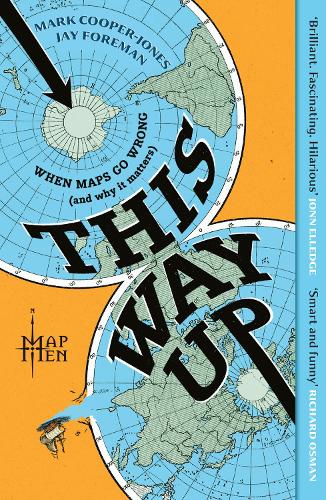
My next review is of This way up: when maps go wrong and why it matters by Mark Cooper-Jones and Jay Foreman – a book about maps with something wrong with them, sometimes the errors are accidental but others are deliberate. It is based on the authors’ YouTube channel – Map Men – which has a rather broader scope.
The style of the book is very relaxed but varies from chapter to chapter, one is a podcast transcript, whilst another is a series of fictional letters. One chapter is one sentence long, asking whether a globe is a map (it isn’t).
The chapters are pretty much entirely independent of one another, although the authors note that Google Maps is a little bit of a recurring theme.
This Way Up sometimes talks about when maps are just wrong, for example IKEAs world map which omitted New Zealand, this mistake is sufficiently common that there’s a MapsWithoutNZ reddit. Related to this are erroneous maps on the TV. Both of these arise from the technical process of getting maps into production.
All maps are likely “wrong” because they contain fake places known as copyright traps to catch out people copying them – the chapter on this involves the fictional town of Aglow in the Catskill mountains which has been cited as a copyright trap but mysteriously became a real place – perhaps so that a copier could avoid a copyright challenge!
Some maps are “wrong” for political reasons, in disputed territories such as Kashmir or Taiwan. The UK has a relatively benign version of this, it is now illegal for public bodies to put Shetland in a box in public maps. I struggled with this chapter because it was written as a poem!
In the Soviet Union maps were routinely censored or rendered inaccurate for reasons of secrecy, an exercise in futility once satellite imagery became routinely available.
There are a couple of maps on the birth and growth of the United States, one illustrates it is ill-advised to base borders on vaguely known geography. The northern border with Canada in the west was based on the north west extremity of the Lake of the Woods – a rather intricate body of water, and a projection west to the Mississippi River which it turned out didn’t go so far north. The second map relates to the Donner Party, a group of American settlers heading out to California whose voyage ended in cannibalism. They had left Independence in Missouri rather late in the season which meant they risked being caught by snow in the Sierra Nevada mountains. As a result of this time pressure, they elected to take the “Hastings Cutoff”, a route promoted with a map – inaccurately as it turned out – which would have saved them time.
The “Mountains of Kong” appeared on maps of West Africa following James Rennell’s 1798 map, they persisted through the 19th century and have actually appeared on a map published in 1995. They don’t actually exist, which has been known since about 1890. Rennell had added them to his map on the basis of very limited information and with a desire not to leave blank spaces, his maps were used as the basis of further maps since original cartographic information was in short supply.
I liked the idea of the Situationists who got their own chapter illustrated by the two authors attempting to meet up in London using a map of Paris. The Situationists were an anti-capitalist French group formed in 1957 who believed in making spectacles, and one way of doing this was to navigate a city at random, using the “wrong” map helps this process.
Technically interesting was the creation of the ITV regions in the UK, these arose from the 1954 legislation to end the BBC monopoly on broadcasting (the campaign for this used the slogan “freedom of the knob”!) . The regions were sometimes culturally illogical because transmitters were costly and worked by line of sight, this meant that, amongst other things, South Wales was grouped with Bristol. Also interesting that London had two franchises, one for weekdays which went to Thames and the other for weekends, won by London Weekend Television! The ITV regions were part of my youth, they went into decline when Channel 4 was launched in 1982, and further when the franchises were auctioned in the early nineties.
I’ve read before about the issues of mapping in India, it features in The Address Book by Deirdre Mask. In the city slums many streets are nameless largely as a result of their informal creation but also because the Indians were left with many colonial street names which they didn’t particularly like. In This Way Up addresses and directions in India provide an opportunity to talk about Google’s efforts to improve direction descriptions by the use of landmarks which is how people in Indian were found to describe routes. Actually this is more generally true, I may be vague about street names in my area but I definitely know the landmarks.
The Marshall Islands were very intensively mapped by the Americans prior to the post-war atomic bomb tests conducted there which led to the invention of the more powerful fusion bomb. The surveys were done so that the impact of those tests could be measured. They produced bigger explosions than expected leading to the evacuation of a number of the islands due to long-lived fallout, a number of smaller islands were entirely erased from the map. Also in this chapter were the stick maps that the Marshall Islanders used for navigation.
The final chapter talks about the coming of sat nav and the Google Map, tracing route finding technology from Roman itineraries to a medieval version of such; a scrolling itinerary linked to the turning of a cars wheels from the 1930s (the Iter Avto); audio itineraries, recorded on tape, from the early seventies; the Philips Carin digital map finally resulting in the sat nav we now today which was a luxury car add-on in the nineties and then in everyone’s hands in the form of the smartphone from 2009.
An excellent book for holiday reading, not so good if you are looking for something a little more academic.