Tag: History

Science is Vital – history repeating 1667

I’m reading Thomas Sprat’s “History of the Royal Society of London, for the improving of Natural Knowledge“* published in 1667. He’s just mentioned that following the return of Charles II much spending has been made on public works and goes on to say:

This general Temper being well weigh’d; it cannot be imagin’d that the Nation will withdraw its Assistance from the Royal Society alone; which does not intend to stop at some particular Benefit but goes to the Root of all noble Inventions, and proposes an infallible Course to make England the Glory of the Western World.

This seems terribly relevant to current circumstances, he does spoil it slightly by going on to say:

There is scarce any Thing has more hindered the true Philosophy than a Vain Opinion, that men have taken up, that Nothing could be done in it, to any purpose, but upon a vast Charge, and a mighty Revenue.

 Old Sprat had a fine way with words!

*Quotes are from p78-79

Book Review: The Fellowship by John Gribbin

an_experiment_on_a_bird_in_an_air_pump_by_joseph_wright_of_derby_1768 I’ve written previously about the Royal Society via the medium of book reviews: Seeing Further, Joseph Banks and Age of Wonder, and also in a data mangling exercise. This post is about “The Fellowship: The Story of the Royal Society and a Scientific Revolution” by John Gribbin, it describes the scientific world before the Society and the founding of the Royal Society. As with many books about this period, the front cover of my copy features “An experiment on a bird in the Air pump” by Joseph Wright of Derby and so that is the image I use to decorate this post. Following my usual scheme this review is really an aide memoire as much as a review.

The book opens with a set of brief biographies, starting with William Gilbert of Colchester (1544-1603), and his scientific study of magnetism: de Magnete (1600). This work on magnetism was unusual for it’s time in that it was very explicitly based on experimental observation, rather than the “philosophising” of Aristotelian school which imputed that the world could be understood simply by thinking. William Gilbert is relatively little known (ok – I didn’t know about him!), perhaps because his work was in a relatively narrow field and was superseded in the 18th century by work of people like Michael Faraday furthermore Gilbert seems to have spent most of his life practicing as a doctor with his scientific work playing only a small part of his life.

Next step is Galileo Galilei (1564-1642). He continued in the tradition of William Gilbert, eschewing the philosophical approach for experiment. In contrast to Gilbert, Galileo made contributions across a wide range of science for a long period – promulgating technology such as telescopes, microscopes and computing devices. This likely explains his greater fame. A detail that caught my eye was that as a professor of mathematics at the University of Pisa he was paid 60 crowns per year, whilst the Professor of Medicine gained 2000 crowns. For many early scientists, medical training appears to be the major scientific training available.

Francis Bacon (1561-1626) was more important as a parliamentarian, lawyer and courtier than a scientist. I link reluctantly to wikipedia in this instance, since in the opening paragraph they seem to be repeating the myth that he met his end through stuffing snow into a chicken to see if this helped preservation. His fame as a founding father of modern science is based largely on a book he didn’t write in which he intended to describe how a scientist should work – a scientific method. Perhaps more notably he had a vision as to how science might function in society at a time when there was no such thing as a scientist. It is apparently from Bacon that Isaac Asimov got his “Foundation”; it is the name of an organisation of scientific Fellows found in Bacon’s fictional work New Atlantis. Finally we are introduced to William Harvey (1578-1657), who identified the circulatory system for blood in the human body by a process of observation and experiment (published in De Motu Cordis (1628)) he was primarily a physician.

The point of this preamble is to say that, as the founding of the Royal Society approached, a number of people had started doing or proposing to do a new kind of science (or rather natural philosophy as it would have been called). The new natural philosophy involved doing experiments, and thinking about them – it was experimental science in contrast to the “received wisdom” from the ancient Greeks which was certainly interpreted to mean at the time that thinking was all that was required to establish true facts about the physical world. It’s not really accurate to say that one person did this and everything changed: rather that a shift had started to take place in the middle years of the 16th century. The foundation of the Royal Society can be seen as the culmination of that shift.

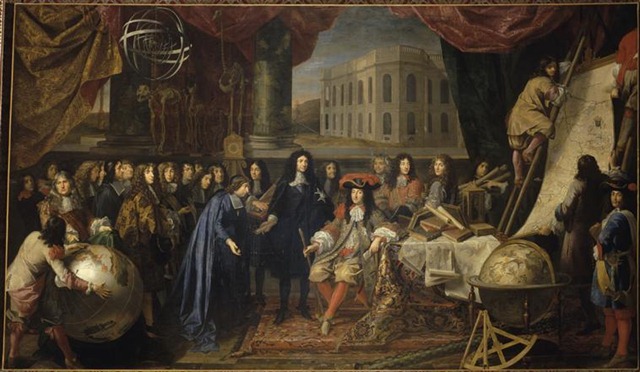
The Royal Society was founded at Gresham College in London on 28th November 1660, although it’s origins lay in Oxford where many of the group that would go on to form the Society had been meeting since the 1640’s. The Royal charter of the Society was agreed a couple of years later. The central figure in the Oxford group was John Wilkins (~1614-1672). The original Society included Christopher Wren, Robert Boyle and Robert Hooke amongst others. What striking is the political astuteness of the founding fathers as the monarchy returned to England in the form of Charles II, the first President, Viscount Brouncker, was a Royalist and the Society clearly identified that a Royal seal of approval was what they required from the very beginning. The Society had an air of purposefulness about it, not of airy philosophising for the amusement of gentlemen. The Society started publishing the worlds first scientific journal, “Philosophical Transactions”, and commissioning a history of their founding by Thomas Sprat only a few years later.  As a scientist I have picked out those names that mean most to me, however it’s very clear that the Royal Society was more than a group of scientists meeting to talk about science and the other less scientifically feted Fellows were equally important in the success of the Society.

Gribbin’s book then goes on to consider three men important in the early life of the Royal Society. Firstly: Robert Hooke (1636-1703), originally scientific assistant to Robert Boyle (1627-1691) who became the Society’s first “Curator of Experiments”. Prior to his appointment the Fellows appeared to be poorly organised in terms of providing weekly demonstration experiments for the Society’s education. Hooke was a really outstanding scientist, a skilled draftsman and maker of scientific equipment. The reason Hooke is not better known is largely down to Isaac Newton, with whom he had a longstanding feud and who outlived him. Newton (1643-1727) does not need further introduction as a scientist, his role in the Royal Society was to provide scientific gravitas (after Hooke had died) he was also President of the Society for the period 1703-27. Edmond Halley (1656-1742) was more important to the Society on the administrative side, he is chiefly remembered from the scientific point of view for his prediction of the return of a comet calculated using Newton’s theory of gravitation. He also spent a great deal of time persuading Newton to publish and trying to extract data from Flamsteed (the Astronomer Royal). In addition to this he invented a diving bell, wrote the first article on life annuities, published on the trade winds and monsoons, made observations of the stars of the Southern hemisphere and went on several scientific expeditions.

Some miscellaneous thoughts that arose as I read:

  • Royal patronage, in this instance by Charles II, was important for the Society in this period and later by George III – as described a little in Age of Wonder.
  • On the face of it astronomy is blue-skies research, but at the time the precise measurement of the position of the stars was seen as a route to determining the longitude – an important practical problem.
  • It’s notable that the persistent anecdotes about the scientists mentioned here i.e. Francis Bacon and the frozen chicken, Newton and the apple falling from the tree and Galileo dropping things from towers, originate from the earliest biographies often written by people who knew them personally. These anecdotes have later been found to be rather fanciful, but nevertheless have persisted.
  • There was serious feuding going between scientists in the early years of the Society!

Overall I enjoyed this book, although it does sometimes have the air of a collection of short biographies of men who are already relatively well known. The most interesting part to me was the core part around the founding of the Society, bringing in some of the lesser known members and also highlighting the importance of the non-scientific aspects of the Society in it’s success.

In terms of scientific history reading, where next? “God’s Philosophers” by James Hannam seems relevant to understanding scientific activities prior to those covered in this book. A deeper investigation into Edmond Halley seems worthwhile, and I should also make another attempt at the Thomas Sprat history of the Royal Society.

Further reading

  1. Joseph Banks” by Patrick O’Brian.
  2. “Seeing Further” edited by Bill Bryson.
  3. God’s Philosophers” by James Hannam.
  4. Age of Wonder” by Richard Holmes.
  5. The Curious Life of Robert Hooke” by Lisa Jardine.
  6. Hostage to fortune” by Lisa Jardine and Alan Stewart, which is a biography of Francis Bacon.
  7. The History of the Royal Society of London, for the Improving of Natural Knowledge” by Thomas Sprat.
  8. Isaac Newton: The Last Sorcerer” by Michael White.

Book review: The World of Gerard Mercator by Andrew Taylor

Once again I have been reading, this time “The World of Gerard Mercator” by Andrew Taylor. As before this blog post could be viewed as a review or, alternatively, as some notes to remind of what I have read. Overall I enjoyed the book, it provides the right amount of background information and doesn’t bang on interminably about minutiae. I would have liked to have seen some better illustrations, but I suspect good illustrations of maps of this period are hard to come by and a full description of Mercator’s projection was probably not appropriate.

The book starts off with some scene setting: at the beginning of the 16th century the Catholic church were still keen on Ptolemy’s interpretation of world geography in fact to defy this interpretation was a heresy and could be severely punished. Ptolemy had put down his thoughts in Geographia produced around 150AD, which combined a discussion of the methods of cartography with a map of the known world. As a precedent Ptolemy’s work was excellent, however by the time of the 16th century it was beginning to show it’s antiquity. Geographical data, in Ptolemy’s time, from beyond the Roman Empire was a little fanciful, and since the known world was a relatively small fraction of the surface of the globe the problems associated with showing the surface of a 3D object on a 2D map were not pressing. Ptolemy was well aware of the spherical nature of the world, Eratothenes had calculated the size of the earth in around 240BC, he stated that a globe would be the best way of displaying a map of the world. However, a globe large enough to display the whole world at sufficient detail would have to be very large, and thus difficult to construct and transport.

Truly global expeditions were starting to occur in the years before Mercator’s birth: Columbus had “discovered”  the West Indies in 1492, John Cabot made landfall on the North American landmass in 1497. Bartolomeu Dias had sailed around the Southern tip of Africa in 1488, Vasco da Gama had continued on to India in 1497, around the Cape of Good Hope. The state of the art in geography could be found in Waldseemüller’s map of 1507, showing a recognisable view of most of our world. Magellan‘s expedition would make the first circumnavigation of the globe in the early years of Mercator’s life (1519-1522).

Mercator was born in Rupelmonde in Flanders on 5 March 1512, he died 2 December 1594 in Duisburg in what is now Germany at the age of 82. This was a pretty turbulent time in the Netherlands, the country was ruled by Charles V (of Spain) and there appears to have been significant repression of the somewhat rebellious and potentially Protestant population. Mercator was imprisoned for heresy in Rupelmonde in February 1543, remaining in custody until September, many in similar circumstances were executed, however Mercator seems to have avoided this by a combination of moderately powerful friends and a lack of any evidence of heresy.

Mercator’s skill was in the collation and interpretation of geographical data from a wide range of sources including his own surveys. In addition he was clearly a very skilled craftsman in the preparation of copperplate engravings. He was commercially successful, manufacturing his globe throughout his life, as well as many maps and scientific instruments for cartographers. He also had a clear insight into the power of patronage.

His early work was in the preparation of maps of the Holy Land (in 1537) and Europe (in 1554), along with a globe produced in 1541. The globe seems to be popular amongst reproducers of antiquities, you can see details of it on the Harvard Map Collection Website.

Mercator is best known for his “projection”, in this context a projection is a way of converting the world – which is found on the surface of a 3D sphere into a flat, 2D map. Mercator introduced his eponymous projection for his 1569 map of the world, illustrated at the top of this post. The particular feature of this projection is that if you follow a fixed compass bearing you find yourself following a straight line on the Mercator projected map. This is good news for navigators! The price you pay for this property is that, although all regions are in the correct places relative to each other, their areas are distorted so those regions near the poles appear much larger than those near the equator. Mercator seems to have made little of this discovery, nor described the method by which the projection is constructed – this was done some time later, in 1599, by Edward Wright. Prior to maps following Mercator’s projection navigation was a bit hit and miss, basically you headed up to a convenient latitude and then followed it back to your destination – an inefficient way to plan your course. If you’re interested in the maths behind the projection see here.

In terms of it’s content the 1569 map shows Europe, Africa and a large fraction of Asia much as we would see it today, certainly in terms of outline. The Eastern coast of North and South America is fairly recognisable. The map fails in it’s representation of the West coast of America – although to give credit where it is due, it at least has a west coast. The landmasses indicated at the northern and southern poles are close to pure fantasy. The Southern continent had been proposed by Ptolemy as a counterbalance to the known Northern continents – with no supporting evidence. Exploration of the far North was starting to occur during Mercator’s life, with expedition such as that of Frobisher.

Mercator is also responsible for the word “atlas” to describe a book containing a set of maps, in this instance he coined the term to describe the volumes of maps he was preparing towards the end of his life, the last of which was published published posthumously by his son, Rumold, in 1595.

Following my efforts on Joseph Banks, I thought I’d make a map of significant locations in Mercator’s life. You can find them here in Google Maps, zoom out and you will see the world in Mercator projection – a legacy from a man that lived nearly 500 years ago.

Book review: Joseph Banks by Patrick O’Brian

Once again I venture into my own idiosyncratic version of the book review: more reading notes than review. This time I’m reading the biography of Joseph Banks by Patrick O’Brian. Joseph Banks has popped up regularly in my recent reading about the Royal Society and the Age of Wonder. He was on Captain Cooks trip to Tahiti, and then went on to serve as President of the Royal Society for 42 years – the longest term of any President. The Inelegant Gardener has been reading about Kew and various plant hunters, and Sir Joseph crops up there too. Despite his many talents, there are relatively few biographies of Banks, and he is relatively unknown.

Sir Joseph was born of a wealthy family from Lincolnshire, he was educated at Harrow, Eton and then Oxford University. At some point in his school years he became passionately interested in botany, and whilst at Oxford he went to the lengths of recruiting a botany lecturer from Cambridge University to teach him. The lecturer was Daniel Solander, a very talented student of Carl Linnaeus, who would later accompany Banks on his trip around the world with Captain Cook, they would remain close friends until Solanders death in 1782.

Sir Joseph’s first trip abroad was to Newfoundland and Labrador in 1766. The area had been ceded to Britain by France, but there was an international fleet of fishing boats operating in it’s waters. Banks made his trip as a guest Constantine John Phipps on HMS Niger, which was sent to the area to keep an eye on things. It seems fairly common for gentleman to travel as guests on navy ships of the time: this was broadly the scheme by which Charles Darwin would later join HMS Beagle on his trip around the world.

1768-1771 finds Banks circumnavigating the world on Captain James Cook’s ship, HMS Endeavour, in Cook’s first such expedition. This voyage was funded by George III following an appeal from the Royal Society for a mission to Tahiti in order to observe the transit of Venus. Banks paid for the contingent of naturalists from his own funds. The stay in Tahiti is much written about largely, I suspect, because they remained there some time. Following their stay in Tahiti, they continued on to New Zealand, which they sailed around rather thoroughly but seemed to land on infrequently as a result of hostile responses from the inhabitants. They then sailed along the East coast of Australia, stopping off on the way at various locations but most particularly Botany Bay. At the time the the existence of Australia was somewhat uncertain in European minds. There’s a rather fine map of their course here and Banks’ journals are available here.

Through the chapters on both these voyages, O’Brian makes heavy use of the diaries of Banks, quoting from them extensively and often between block quotes further quoting Banks’ own words. This may work well for those of a more historical bent, but I felt the need for more interpretation and context. It often feels that O’Brian is more interested in the boats than the botany.

The next episode is somewhat odd: Banks was planning a second trip around the world with Captain Cook but he never went. At almost the last minute he withdrew on the grounds that the Admiralty would not provide adequate accommodation for him and his team scientists. The odd thing is that, despite what appears a fractious falling out, Banks appeared to remain very good friends with both Cook and Lord Sandwich, First Lord of the Admirality at the time. I wonder whether Banks, remembering the 50% mortality rate of his previous voyage with Cook, understandably got cold feet. As a consolation he went off to Iceland in 1772 for a little light botanising, where he scaled Hekla.

Despite recording an extensive journal, collecting a considerable number of anthropological, botanical and zoological specimens as well as a large number of drawings by his naturalist team Banks never published a full report of his Tahiti voyage. He showed the artefacts at his home in Soho Square and prepared a substantial manuscript, with many fine plates but seems to have lost interest in publishing close to the end of the exercise. Throughout his life he produced relatively few publications, this may be a reflection of his dilettante nature: he was skilled in many areas but not deeply expert and so published relatively little.

Banks was elected to the Royal Society whilst on his world tour, and later become President for a 42 year term, until his death in 1820. He made some effort to improve the election procedures of the Society, at the time of his election being in the right social class appeared to be more important than being a scientist. As part of his role as President he was heavily involved in providing advice to government including a proposal to use Australia as a colony for convicts. He was also heavily involved in arranging the return of scientists and others caught up in the wars following the French revolution. In addition to his work at the Royal Society, he also helped found the Africa Association and the Royal Academy.

Kew gardens was created a few years before Joseph Banks became it’s unofficial superintendent (in around 1773) and then director. He had a pivotal role in building the collection: commissioning plant collectors to travel the world, all backed by George III. I must admit that my recent reading has led me to see George III in a new light: as an enthusiastic supporter of scientific enterprises, rather than a mad-man. George III and Banks also collaborated on a programme to introduce merino sheep from Spain, which had potentially huge commercial implications. Banks was seen as a loyal courtier.

Through his life it’s estimated that Banks wrote an average of 50 letters per week almost entirely in his own hand, although they were fantastically well organised during his life, on his death they were rather poorly treated and dispersed. Warren R. Dawson produced a calendar of the remaining correspondence. I’ve not found this resource online but a treatment like this Republic of Letters would be fantastic.

I suspect a comprehensive biography of Joseph Banks is exceedingly difficult to write; this one seemed to cover voyaging well but I felt was lacking in botany and his scientific activities at the Royal Society. Perhaps the answer is that a comprehensive biography is impossible, since he had interests and substantial impacts in so many areas. There was simply no end to his talents!

Footnote
In the style of a school project I have made a Google Map with some key locations in Joseph Banks’ life.

Seeing Further: A Blagger’s Guide (Part 2)

My writings on Seeing Further: The Story of Science and the Royal Society became unmanageably long, so I have split it into two parts, this is the second part, the first part can be found here.

In the earlier chapters there was much philosophy and history. Henry Petroski writes on bridges, which I must admit surprised me a little as an area of interest for the Royal Society but the link is there. When Robert Stephenson proposed the design for the original Britannia Bridge it was William Fairbairn, soon to become a fellow of the Royal Society, who carried out experiment studies to establish the shape of the iron box-sections. This was done by testing the strength of scale models, and progressively increasing the size of the models – extrapolating the results to the full-size bridge. Later he went on to investigate metal fatigue, which had led to several serious rail disasters in the 19th century.

We’re heading into living memory now, with Georgina Ferry’s chapter on structural biology through the medium of x-ray crystallography. A field in which Britain led the world in the middle of the 20th century. This period sees the election of the first female fellow of the Royal Society, Kathleen Lonsdale, in 1945, who made some of the first determinations, by crystallography, of the structure of small molecules. Following this Dorothy Hodgkin determined the structure of penicillin in secret work during World War II. This type of investigation reached a climax with the determination of the structures of first proteins, massive efforts taking Hodgkin 35 years for insulin and Max Perutz taking 22 years for haemoglobin. Georgina Ferry’s biography of Dorothy Hodgkin is well worth a read and covers in more depth much of the material in this chapter.

Steve Jones, geneticist, provides a chapter on biodiversity. We believe that evolution provides a good explanation of how species arise and change over time. The subject of biodiversity addresses the question: how many species can we expect to find in a particular environment? And the answer is we don’t really know,  there don’t seem to be any rules that allow us to predict biodiversity. There are some observations, such as biodiversity is greater in the tropics than elsewhere but no real understanding of why this might be.

C.P. Snow wrote about the two cultures, what is less well reported are his comments on the gulf between “pure” sciences and applied sciences. Philip Ball expands on this theme, and makes a plea for a better appreciation of the engineers and technologists, under whose aegis much essentially scientific work is done. One of his examples are plastics (or polymers), the field in which I am trained.

Paul Davies asks how special are we? In cosmology we hew to the Copernican Principle, the idea that there’s nothing special about earth, nor the sun nor even the galaxy we find ourselves in: if we look around the universe we expect to find planets, suns, galaxies just like our own. It is only when we enter the highly speculative area of the multiverse that this part of the Copernican Principle starts to break down. Related to this questions is the more open one of “Are we, intelligent life forms, special?”. We simply don’t know whether life, or intelligent life is common in the universe.

I hope you’re not getting bored of this machine gun delivery of chapter synopses!

Ian Stewart writes on the importance of mathematics, often hidden from view even to those in the know. He uses the example of the recent Mars missions, which fairly evidently use the mathematics of Isaac Newton (a fellow of the Royal Society), but less obviously the work of George Boole (another fellow living 1815-1864). Boole is responsible for providing the foundations of modern computing through his Boolean logic – the ones and zeros on which computers thrive. Compression and error-correction algorithms also make heavy but invisible use of mathematics. JPEG compression, in particular, uses the work of, foreign member of the Royal Society, Joseph Fourier (1768-1830).

John D. Barrow is up next, he is a cosmologist. He starts off explaining the underlying simplicity of physical laws, and the attempts to unify the theories of different forces into a single “Theory of Everything”. The current best candidate for this theory of everything is string theory. He then discusses chaos and complexity: simple laws do not lead to simple outcomes. The behaviour of a pile of sand is not easy to predict.

The next three chapters have a a slight theme running through them. Oliver Morton starts off with the “blue marble” image captured from Apollo 17. This demonstrates, self-evidently, the spherical nature of the earth but beyond this it implies an isolation and stasis. There is little evidence of movement, or process taking place. Morton’s point is that the Earth is not a static system: light from the sun enters and great cycles turn over carbon, nitrogen and water in the system, taking these chemicals through the earth and the sky. This leads into thinking about climate change.

Maggie Gee starts off by introducing about apocalyptic writing, fiction about the end of the world (or at least after a great disaster). Gee is an author of such fiction, including The Flood and The Burning Book. I must admit I’ve always seen this as a genre that doesn’t really ask me to contemplate my own end, but rather selfishly imagine my survival in the aftermath. After this introduction she then moves on to discuss global warming and the part that writers might play in it’s communication. I found this a very interesting perspective. Most of the authors in this volume I’ve read before, Maggie Gee is one I haven’t read but aim to address this lack.

Continuing the global warming theme, Stephen H. Schneider is a climate scientist who has long been involved in the the Intergovernmental Panel on Climate Change (IPCC), as an normal author in the first two reports and a lead author in the second two reports. In this chapter he talks about introducing standardised language to describe uncertainty into the fourth assessment report, known as AR4. There is a clear need to do this because if the scientists writing the report don’t communicate their assessments of uncertainty then others, less-qualified, will do it for them. It’s not that uncertainty was unrecognised in previous reports, but it’s communication was not clear. Schneider was involved in preparing clear advice in this area. Persuading scientists to use well-defined language to communicate uncertainty seems to have been a battle.

Gregory Benford talks about time, firstly he talks about the Deep Time discovered in the 19th century by geologists such as Charles Lyell FRS. This was the realisation that the earth had been around rather longer that the few thousand years that a literal reading of the bible suggested. This change in thinking was based on an assumption that the changes in landscape seen in the present were largely all that was required to create the landscape, this is in contrast to the prevailing view of the time based on cataclysms like the biblical Flood. Also, Darwin was of the view that evolution would have required hundreds of millions of years to lead to the diversity of species seen today.  The great age of the earth was subsequently confirmed using radioactive decay measurements. Also discussed is time and it’s merging into space which is central to Einstein’s general theory of relativity. Benford is a scientist and science-fiction writer, I can recommend Cosm, a story about physicists who create a universe in a particle accelerator and drive it off in a pickup truck.

And finishing off with a chapter by Lord Rees, the current President of the Royal Society. Rees looks forward  to discoveries in the next 50 years; at various times in the past people have claimed we are coming to the end of science. Rees points out that each new discovery opens up new areas, so feels there’s no risk of us running out of science to do. He also writes of the continuing role of scientists as advisers, a task that the Royal Society continues to coordinate and drive. And the finally on moral responsibilities of scientists, on which I wrote a little previously with regard to the atomic bomb.

All in all I found this a very enjoyable read, some of the philosophical and literary chapters I would not have read as full length treatments but enjoyed in shorter form. The links to the Royal Society are tenuous in many of the chapters, so perhaps it’s best to approach this book as a sampler for fine science writing.