Tag: History

Book Review: The First American by H.W. Brands

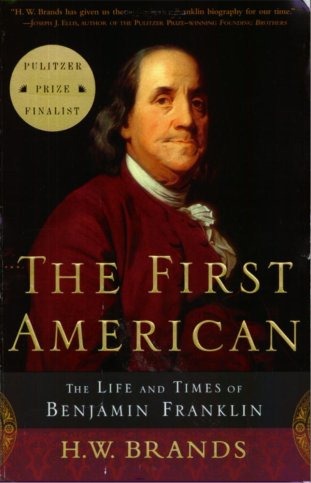
first_americanBenjamin Franklin (1706-1790) is someone who has crossed the paths of a number of protagonists in books I have read on the history of science, including Antoine  Lavoiser, Joseph Banks and the Lunar Society. I thought I should read something on the man himself: “The First American: The Life and Times of Benjamin Franklin” by H.W. Brands.

Franklin trained as a printer, as an apprentice to his brother. This was a route into learning since he got to read a lot, interacted with learned men and also started writing, when his brother launched a newspaper in their hometown of Boston – one of the early campaigns of this newspaper was against vaccination for smallpox. In the later years of his life he set up a printing press at his residence at the edge of Paris. Franklin ran away to Philadelphia before his apprenticeship finished, making his first trip to England to learn more of his trade with the (moral if not financial) support of the governor of Pennsylvania. This is another example, like Edmond Halley, of rather precocious responsibility which was not so unusual at the time. It turns out the publication of almanacs was lucrative, as was his printing work for the Pennsylvania Assembly. By the 1750s, only in his forties, he was able to step back from his business and carry on earning a good income from it. His trade as a printer seems to me important in honing his writing skills and getting his opinions out in the public domain.

I picked upon Benjamin Franklin primarily for his work as a “scientist”. The first substantial mentions of science in this book come around 1743, it is at this point he founds the American Philosophical Society and does work on a more efficient stove (which he refuses to patent), although in 1726 he is found making observations of a lunar eclipse on his return trip from England. This suggests a scientific turn of mind from a relatively young age. A few years later he is doing original and well-regarded work on electricity, as well as recommending the use of pointy lightning conductors (of great practical importance). He did some work relating a little to my own field: the spreading of oil and water as well as evaporative cooling, the Gulf Stream and some earlier thoughts on meteorology (this seems to strike a cord with some later proposals by Erasmus Darwin).

When Franklin was born Pennsylvania was in the hands of the Penn family, known as the proprietors – other states were controlled directly by the Crown via Royal governors. For much of his life Franklin considered himself to be British but by the end, the United States of America had become a newly minted nation with Franklin a pivotal figure in its creation. I suspect the causes of the War of Independence are the subject of many books. The battle cry of “no taxation without representation” has taken popular hold as a motivation, although at the time the British living in Britain were taxed with not very much representation, this taxation cause is certainly the theme that Brands follows. Also relevant was colonial support for the British in battles against the French, for which they felt little gratitude and that the British gave up in diplomacy much of that which they had paid for in blood. Ineptness on the part of the British political establishment and George III also plays a large part. Franklin’s part in the War of Independence is played politically in London in the run-up to the war, in France during the war – to garner their support, and finally in Philadelphia where he is heavily involved in the creation of the United States of America.

Throughout his life Franklin was a civic activist, a community politician, setting up the Junto (something of the character of the Lunar Society) and the American Philosophical Society (more like the Royal Society). He also founded fire brigades, a Library Company, an academy and a militia. In a sense the United States of America were the culmination of this civic activity.

For much of the last 25 or so years of his life, from 1757,  Franklin was resident in either London or Paris. In London as a representative of the Pennsylvania assembly to the British state, and in Paris similar when their help was sought in the war against the British. He appears to have fitted well into high society, and been exceptionally highly regarded in both countries. No doubt this is in part due to the formal position he held but prior to his arrival he was known in both cities via his interactions with learned societies (the Royal Society and the Académie des Sciences). He strongly considered staying the rest of his life in London, which is odd since his wife was unwilling to join him there.

In the same way that Poirier’s biography of Lavoisier introduced me to the French Revolution, this book on Franklin has introduced me to the American War of Independence. It’s like sneaking vegetables into a child by hiding them in something they like!

Footnotes

My Evernotes on this book can be found here.

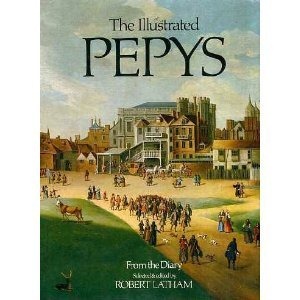
Book Review: The Illustrated Pepys edited by Robert Latham

41dJ gYoaLL._SL500_AA300_In this post I review “The Illustrated Pepys”, extracts from Samuel Pepys’ diaries edited by Robert Latham and enhanced with illustrations from the period. You can download the full Pepys diaries from Project Gutenberg (here) in the earlier 1893 edition and the www.pepysdiary.com website has loads of additional information, it is working it’s way through the diary and will reach the end in May next year.

I feel somewhat ashamed for going for the “illustrated” and edited version which contains approximately one twelfth of the complete diaries, it feels like dumbing down but to be honest I struggle with 17th century English. However, I did enjoy the illustrations.

Samuel Pepys was born in 1633, his family appears to have been relatively well-connected, he attended grammar school, St Paul’s School the Magdalene college at Cambridge funded by two exhibitions and a grant from the Mercers Company (his father was a tailor). In 1649 he was present at the execution of Charles I.

Prior to the start of the diary in 1660 he had married Elisabeth de St Michel, a 15 year old Hugenot, in 1655. On 26th March 1658 he was “cut for the stone” that’s to say had a lithotomy to remove stones from his bladder, this was a painful and dangerous operation at the time. He celebrates the anniversary of this day in each year through the diary – under the circumstances I think I would too!

After university he starts work as clerk to Sir George Downing at the Exchequer and he was also a secretary to Sir Edward Montagu, a relative of his father’s who was later to become 1st Earl of Sandwich. The diary begins in 1660 when Pepys is 27 years old, on the eve of the Restoration, in which he is involved as a member of the fleet which travels to Holland to bring back Charles II as part of Montagu’s retenue. On his return he becomes Clerk of the Acts to the Navy Board, this seems to have been a relatively senior, but not top, position. Later in the diary he describes giving evidence to a committee of parliament on the conduct of the navy in the Second Anglo-Dutch War.

The diaries are an interesting mishmash of the mundane and high politics. Pepys was living in interesting times, he lived in London during the coronation of Charles II, the plague and the Great Fire – all events covered in his diaries.

Pepys has regular sexual encounters with women who are not his wife, he often drops in to an argot of foreign languages (French, Spanish and latin) to describe these encounters. Late in the book his wife catches him fondling their maid, Deb Willet and the repercussions of this last for several months. Interestingly he describes a later, non-sexual meeting with Deb in his argot. The diaries were written in shorthand and were clearly not intended for general readership, he expresses a degree of remorse and guilt over his affairs, so to me it seems this use of language is to separate him from his disreputable acts.

Aside from the womanising Pepys entertained himself with music making with his wife and friends, going to plays and trips into the countryside. Servants seemed like more of the family for Pepys than I imagined, he and his wife give two of their servants who marry a substantial wedding gift for their departure, he also talks of working with labourers such as carpenters who come to his house to work.

I wrote a diary for a period between 2000 and 2005, looking back at them the similarities with Pepys diaries are striking. The little domestic details, the meetings with friends, the extended descriptions of current events, the hints of the work he is currently engaged in, the brief formulaic entries for those days when you just don’t feel like writing, his joy at new clothes and gadgets (like a carriage). I should hasten to add for the benefit of Mrs Somebeans that no sexual encounters with anyone are described in my diary!

The details of his relationship with his wife are touching and domestic, he talks of them laying long and talking, of returning to share a bed with her after she has had a cold. He also describes accidently elbowing her in the face as he wakes with a start and grumbles about her leaving her belongings in a coach, grudgingly admitting at the end of the entry that she had given the items into his care.

I come to the diaries having read Alan Cook’s biography of Edmond Halley (reviewed here), a contemporary of Pepys. Cook’s biography of Halley is very dry, you can almost feel the transition between different sets of formal records. The personality of Halley can only be imagined. The life and character come from the diaries of associates such as Samuel Pepys, Robert Hooke and John Evelyn. Looking more widely biographies of Charles and Erasmus Darwin are both given character by their extensive surviving personal letters and diaries.

British diaries : an annotated bibliography of British diaries written between 1442 and 1942” compiled by William Matthews lists the diaries known from the period in which Pepys lived, they are sparse: a handful in each year from people in a range occupations. Pepys diaries are well-known because they are preserved, along with his large library, they cover a very active period of history in which Pepys plays a small role close to the centre of action. They are readable and cover both the professional and personal.

He finishes the diary in May 1669, fearing for his eyesight which subsequently improves. Elisabeth, his wife, dies shortly after the end of the diary; over the succeeding years he takes up more senior roles in the navy, becomes and MP and serves briefly as President of the Royal Society. He dies in 1703.

Foot notes

You can see my rather incomplete Evernotes on the diaries here, I recommend www.pepysdiary.com for more detailed exploratory with added details and explanations.

Book review: Edmond Halley Charting the Heavens and the Seas by Alan Cook

EdmondHalleyEdmond Halley (1656-1742) was one of the key figures in the early history of the Royal Society. He is best known for predicting the return of his eponymous comet but over-shadowed by contemporaries such as Isaac Newton, Robert Hooke, Robert Boyle, Christopher Wren and Samuel Pepys. The biography I review here is “Edmond Halley: Charting the Heavens and the Seas” by Alan Cook.

Cook divides Halley’s life into three phases:

  • His early life including trips to St Helena (1677-78) to compile the first comprehensive star catalogue of the southern hemisphere; a visit to Danzig to establish the accuracy of Johann Hevelius’ star catalogue (1679), along with further travel to visit astronomers in France and Italy. This phase culminates in the publication of Newton’s Principia (1687), which Halley paid for and managed.
  • In a second phase Halley is found making two tours of the Atlantic (1698-1700), venturing to the very far south, with a view to establishing the longitudes (in particular) of various locations and measuring meterological and magnetic properties as he goes. He does this on the request of the king, as a member of the Navy. Subsequently he is sent to the Adriatic Sea (1703) to survey various potential naval bases for the English Navy. He also conducts a survey of tides in the English Channel (1701), following an earlier survey of the approaches to the Thames (1689)  and is involved in diving operations on the wrecked frigate Guiney to salvage its cargo (1691), inventing a diving bell and diving suit for the purpose. He is also Deputy to Newton at the Chester Mint (1696-97), which was created along with four other country mints for the Great Recoinage.
  • Finally he becomes Savilian Professor of Geometry at Oxford University in 1704 where he prepares a translation of Apollonius’s Conics – a classical text on geometry. After John Flamsteed dies (1720), Halley takes his place as Astronomer Royal at the Royal Greenwich Observatory. a post he holds until his death aged 85 in 1742.

The striking thing about the first phase of his life is the degree of responsibility and the quality of his connections at an early stage in his life. He goes to St Helena at the age of 20, breaking his study as an undergraduate at Oxford, with the blessing of both the Royal Society and Charles II; Cook comments that this responsibility at an early age is not exceptional at the time but the degree of high level support is notable. On his return the king directs the university to award him a degree. Following this, at the age of 23, he goes to Danzig to make measurements with Johann Hevelius (1611-1687) at the behest of the Royal Society to check out how Hevelius makes his measurements (he uses so-called open sights, rather than the more recently invented telescopic sights) and the Society wishes to know if his claimed accuracy is reasonable. This is a pretty delicate task for a young man!

On his return from Europe he works with Newton on the publication of Principia. Prior to Principia astronomy is about data collection and classification, after Principia there is a theory that will tie all of these data together (even if the calculations are not trivial)  based on the core idea of universal gravitation attraction following an inverse square law. Halley funds the publication of the book, and is responsible for the printing, along the way learns the contents inside-out which he will later apply to the orbits of comets and the motions of the moon. In a way Halley’s prediction of the return of a comet is the proof of Newton’s theory: at the time comets were rather mysterious it was not clear at the time that they were bodies that orbited the sun but by applying Newton’s theory Halley could predict the return of a comet (everyone knew that the planets were in orbits, even if they didn’t know why).

It’s during this time Halley falls out with John Flamsteed (1646-1719) with whom he had been familiar since the creation of the Royal Observatory and Flamsteed’s appointment as Astronomer Royal. The core of the problem seems to be Halley passing on Flamsteed’s data to Newton for his calculations in Principia. Flamsteed later makes everyone he feels is in the Newton camp his enemy, maybe I need to read a sympathetic biography of Flamsteed!

The creation of the Astronomer Royal and the Royal Observatory at Greenwich, along with Halley’s government funded and mandated trips around the Atlantic mark the start of scientific endeavours funded by the government. Prior to this great programmes of observation such as those by Tycho Brahe and Johann Hevelius are essentially the enthusiasms of wealthy amateurs – they die with their masters. For problems such as the determination of longitude there is a need for extended programmes of observation whose results are available to all. In a sense the clash between John Flamsteed and everyone else represents the birthing pains of this switch, he kept “his” measurements close to his chest and was monumentally reluctant to publish them. This is someone who adopts a lifelong program of detailed measurements who, naturally, will collide massively with someone like Halley, who although he undertook such a program late in his life and was a competent observer in his own right, was much more an aggregator of data from other people.

During his life Halley was respected as one of the leading European mathematicians, a reputation which hasn’t really maintained. I feel this is a little unfair, Halley’s strength was in compiling data on, for example, cometary orbits from a range of sources including other contemporary observers, his own measurements and historical sources. He then applies the most recent theory of the time to make future predictions – most famously of the return of his eponymous comet. He also devises the program of measurement for the transits of Venus and Mercury, which are conducted on James Cook’s mission after Halley’s death, these are used to determine the size of the solar system. (The key parameter to be measured is simply the length of the transit, rather than the absolute time of its start and end). This process of turning theory, in this case Newton’s theory of gravitation, into practical application is critical but less well recognised than the “original seed”. In contrast to Joseph Banks and Charles Darwin, who were passengers on Royal Navy ships, Halley is master and commander – he has a full Navy commission and salary and is a competent seaman.

Halley’s work on geomagnetism and trade winds is also notable – he publishes the first known examples of “isoclines” to visualise his data – and he makes use of a wide range of measurements from right across the globe. In fact as a classical scholar he also investigates historical data which he incorporates into this work and other independent investigations.

halley_isoline_1701

One longstanding project is the understanding of the motion of the moon, it is relevant because if the location of the moon relative to the fixed stars can be calculated in the future then the moon can be used as a clock to determine the longitude: a grand challenge of the time. As Astronomer Royal Halley sought to record the motion of the moon over the 18 year “saronic” cycle, this is the period over which the moon’s orbit repeats. The results of these observations are not published until after his death.

On subjects such as tides, the magnetic field of the earth, calculations of lunar locations, geomagnetism, the source of the aurora Halley is often producing results that are not bettered for a hundred or so years. 

Halley strikes me as an early version of Joseph Banks, someone with significant scientific reputation but also someone who can be relied on to competently complete difficult tasks – they share a little more in the sense that it is Banks who helps conduct the transit of Venus measurements in Tahiti that Halley described many years before. It also plays to the idea that, at the time, there were no professional scientists such as there are today, the 17th century model is equivalent to a cabinet minister who wins a Nobel prize for physics.

Alan Cook’s book feels very complete in it’s treatment of the source material, in several places he repeats tables of original measurements and covers some of the mathematics in some depth, the appendices contain yet more detail. However, Halley left nothing in the way of a diary or of personal correspondence so Halley as a person does not come through except by his public actions.

Footnotes

If you’re interested these are the notes I made in Evernote as I read (link)

British Wars–presented in fancy Javascript timeline format

Working my way through various bits of scientific history it becomes clear that what is going on outside the lab can have a profound impact on the protagonists. For the early years of the Royal Society the English Civil War and the Restoration had a big impact on the Fellows; the general feeling was “never again” and there was a search for stability and order. Later, in the 18th century, the American War of Independence and the subsequent wars arising from the French Revolution had an impact on The Lunar Men, impacting as it did on trade and their own radical politics. Lavoisier was to find the French Revolution terminal. In the 20th century, scientists were to play a large role in the Second World War; in codebreaking, radar and in building the atomic bomb. This followed a lesser role in the First World War, developing chemical weapons.

As someone whose formal education in history ended at the age of fourteen I thought I should get a feel for the wars going on around the people closer to my interests; this also seemed to be a good opportunity to play with whizzy Javascript timeline technology courtesy of Simile. It turns out the tricky bit is getting Javascript to run inside WordPress, I cheated a little by simply installing the Simile timeline plugin which fixed things in a way I don’t pretend to understand.

The timeline below is derived from a page in wikipedia entitled British Wars, I wanted to go back to the beginning of the 17th century so I supplemented that list with the linked “List of wars involving England”; Great Britain did not exist prior to the Acts of Union in 1707. You can slide the timeline backwards and forth by dragging it with the mouse.


Javascript timeline broken on upgrade to WordPress 3.5, you can see it here now.

I’ve colour coded the wars geographically as follows civil war: blue, Africa: brown, European:green, Americas:red, India:olive, SE Asia:black, New Zealand:purple and Middle East:orange, I have done this slightly erratically. During the 19th century we appear to have engaged in an awful lot of colonial conflicts around the world.

Developing this timeline I have experienced some of the shortcomings of the timeline presentation, I started off with the Cast of Characters in Lisa Jardine’s “Ingenious Pursuits”, entering their birth and death dates, but quickly found I had a rather ugly pile of people whose lives centred around 1680 with outliers before and after that time. Once I started on “British Wars” a second drawback becomes apparent: what is important and what isn’t? In a sense I gave up this decision to the compilers of the Wikipedia page, blindly adding all they had put in. This means the Cod Wars appears alongside the First World War implying some sort of equivalence. They also rate “The Troubles” in Northern Ireland as a war which I struggle to admit.

As a second exercise I tried working out how “important” a war was through numbers of military casualties, for this exercise the full list of British Wars is a bit long so again I left the deciding what was important to someone else, in this case a BBC History timeline, this finds a more manageable 10 major wars over the last 400 years or so. In fact it turns out that the Crimean and Boer Wars had relatively few military causalities, so I have omitted them. Below you can see the number of causalities for each war, expressed as a fraction of the population at that time. The casualty figures come from a combination of Wikipedia and Necrometrics, the population figures from the Historical Atlas.

WarCasualties

This plot lumps together a whole sequence of conflicts from the first plot into “Napoleonic Wars”. I’ve always known that World War I was known as the war to end all wars, that the casualty figures were horrific, but hadn’t appreciated that the Napoleonic Wars were similar in scale compared to the size of the population. Similarly the English Civil War scores highly for casualties but even so is under-represented in this plot since I decided to use the military casualty figures rather than total deaths relating to the war i.e. including civilians and those who died of disease or famine.

This is a rather parochial view but it has got the sequence of wars Britain has undertaken into some sort of chronology for me.

Book review: Ingenious Pursuits by Lisa Jardine

IngeniousPursuits““Ingenious Pursuits” by Lisa Jardine is the second book I have recently recovered from my shelves, first read long ago – the first being “The Lunar Men”. The book covers the late 17th and early 18th century, and is centred around members of the Royal Society in London but branching out from this group. It is divided thematically, with segues between each chapter.

My edition is illustrated with Joseph Wright of Derby’s “An experiment on a bird in the air pump”, painted in 1768. As a developing historical pedant this mismatch in dates has been irritating me!

The book opens with a chapter on Isaac Newton, the first Astronomer Royal John Flamsteed, Edmond Halley and the comet which would eventually take Halley’s name. It’s also an early example of an argument over “open data”, Flamsteed was exceedingly reluctant to give “his” data on the motions of planets to Newton to use in his calculations. Halley is pivotal in this, not so much through the scientific work he did, but through his work as a conduit between the prickly Newton and Flamsteed.

Robert Hooke features strongly in the second chapter alongside Robert Boyle; Hooke had originally been the wealthy Boyle’s pet experimenter – in particular he was operator for the “air pump”, a temperamental device for evacuating a glass vessel. The early Royal Society recognising his skills, persuaded Boyle to allow them to take him on as Curator of Experiments for the Society. Hooke was also involved with Christopher Wren in surveying London after The Great Fire, and designing many of the new buildings. In fact they also designed buildings with one eye to fitting experiments into them, particularly ones requiring a long uninterrupted drop. One sometimes gets the impression of a highly industrious Hooke implementing the vague imaginings of a series of aristocratic Society members. The constant battles with temperamental equipment will ring a bell with many a modern scientist. Robert Hooke is a central character throughout the book, Lisa Jardine has written a biography of him.

Hooke was also responsible for Micrographia a beautiful volume of images observed principally through a microscope, of insects and plants. Antonie Van Leeuwenhoek, a Dutch civil servant and microscopist also supplied his microscopic observations to the Royal Society. It’s interesting that both Leeuwenhoek and later Jan Swammerdam, both based in the Netherlands, were very keen to communicate their results to the Royal Society in London. Interactions with the academiciens in Paris were more formal with another Dutchman, Christian Huygens, a central figure in the French group. Scientific discovery was already a highly international operation.

This was a period in which serious large scale surveying was first undertaken, the French started their great national survey under Cassini. The British, under the direction of Sir Jonas Moore, set up the Royal Observatory at Greenwich, where Flamsteed was employed. Timekeeping was a part of this surveying operation. Finding the latitude, how far you are between equator and pole, is relatively straightforward; finding your longitude – where you are East-West direction is far more difficult. One strategy is to use time: the earth turns at a fixed rate and as it does the sun appears to move through the sky. You can use this behaviour to fix a local noon time: the time at which the sun reaches the highest point in the sky. If, when you measure your local noon, you can also determine what time it is at some reference point Greenwich, for example, then you can find your longitude from the difference between the two times.

To establish the time at your reference point you can either use the heavens as a clock, one method is the timing of the eclipses of the inner moon of Jupiter (Io with a period of 1.8 days), or you can use a mechanical clock. In fact it’s from observations of these eclipses that the first experimental indications of a finite speed of light were identified by Ole Rømer. In the late 17th century the mechanical clock route was starting to become plausible: the requirement is to construct a timepiece which keeps accurate time over long sea journeys, at the equator (the worst case) a degree of longitude is 60 nautical miles and is equivalent to 4 minutes in time. Christian Huygens and Robert Hooke were both producing advances in horology, and would be in (acrimonious) dispute over the invention of the spring driven clock for some time. Huygens’ introduction of the pendulum clock in 1656 produced a huge improvement in accuracy, from around 15 minutes in a day to 15 seconds following further refinement of the original mechanism.

Ultimately the mechanical clock method would win out but only in the second half of the 18th century.This astronomical navigation work was immensely important to nations such as Britain, French and the Netherlands who would even collaborate over measurements in periods when they were pretty much at war. Astronomy wasn’t funded for “wow” it was funded for “where”.

Also during this period there was a growing enthusiasm for collecting things. At the Cape of Good Hope in South Africa, Hendrik Adriaan Van Reede was to start adding more native plants to the local botanic garden on behalf of the Dutch East India Company. The Dutch built their commercial horticulture tradition in this period. In France, botany was only second to astronomy in the money it received from the Academie des Sciences. Again, plants were not collected for fun but for trade. In England Sir Hans Sloane was to start collecting; bringing chocolate back from the West Indies, which he marketed as milk chocolate, popular alongside another exotic botanical product: coffee. He was also to bring back the embalmed body of his employer for the trip, the Duke of Albemarle. Sloane was to continue collecting throughout his life, absorbing the collections of others by purchase or bequest – his collection was to go on to form the foundation of the British Museum collection. In Oxford Elias Ashmole, of Ashmolean Museum fame, was to acquire the collection of the planthunter John Tradescant under rather murky circumstances. The collectors of the time were somewhat indiscriminate and not particularly skilled at organising their rather personally driven collections. In their defence though there was no good taxonomy at the time so raw collecting was a start.

The final thematic chapter is largely about medicine, at the time medicine was in a pretty woeful state. Over the preceding years advances had been made in describing the structure of the human body and William Harvey had identified a function: the circulation of blood. However fixing it when it went wrong was not a strength at that time: surgeons “cutting for the stone” were becoming quite agile but there were few reliable drugs and a wide range of positively unhelpful practices.

The book finishes with an epilogue drawing parallels between the discovery of the structure of DNA, and the intense personal story around it, with the interactions between the people discussed previously at the heart of this book. There is also a “Cast of Characters” which provides a handy overview of the book (should I forget its contents again). Compared to The Lunar Men it is an easier read perhaps because it is more discursive around themes rather than providing great detail.

Footnote

My Evernotes on this book are here